Teeny tiny

This week’s Photo Challenge is called What is it?. The idea is to take an extreme close up of something, so it’s hard to tell what it is.

I’m still getting to grips with my new Canon 450D, but I bought a set of macro extension tubes and I’ve been experimenting.

I may or may not enter one of these, or another one, into the Challenge itself. So I’m not going to say what these are 😛


servepics.com

A while back, my younger brother Edmund wanted a photo blog, just like his big brother’s 🙂

I set him up with a free subdomain from No-IP. The address used to be edmund.servepics.com. I couldn’t fault the service from No-IP, but unfortunately free domains don’t only attract impoverished teenage photographers. They attract spammers and phishers, too.

As a result, the entire servepics.com subdomain is blacklisted by:

  • MSN Messenger. Sending a message including a link to his blog is blocked for an “unknown reason”.
  • Bristol University’s malicious content filtering.
  • My blogs. Any comments or links from his blog are automatically sent to spam, no matter how many times I mark it as not spam.
  • Everyone’s email servers. Any email from this domain is binned by most email providers.
  • Countless other people and services who don’t like online criminals.

So I decided it was time he became a man, and I signed him up for his own domain. You can now see his photos at www.edmundgazeley.co.uk. Enjoy!

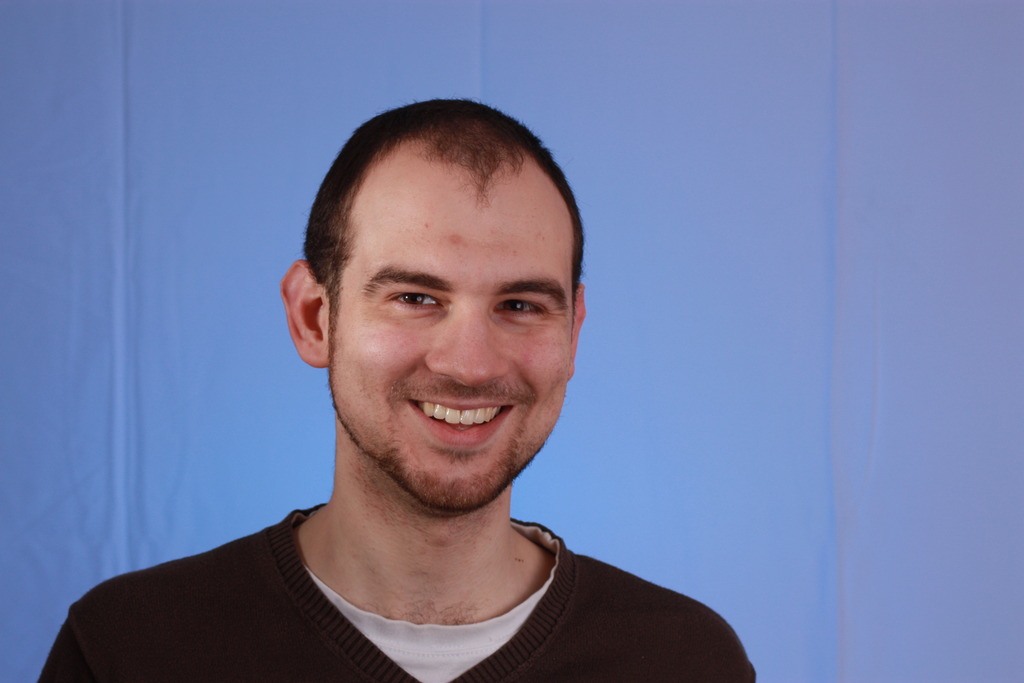
Some self portraits

Over the last few months I’ve amassed quite a bit of photographic lighting equipment but I don’t often get the chance to play with it.

Hana was out this evening, so I moved all the furniture aside and turned my kitchen/living area into a studio. (You can see from the last shot on this page that we don’t have a lot of room).

I set up a white muslin backdrop, lit by a hotshoe flash and blue filter. I set up a snooted and gridded key light to camera left, and a fill light with a shoot-through umbrella to camera right. There was a bit of trial and error before I got the levels right.

The camera was three or four metres away, with a Tamron 70-300mm zoom lens. My Canon 18-55mm lens wasn’t quite close enough.

Taking self-portraits with a 450D is a lot easier than with my other cameras, that require a mechanical shutter release. The Canon has an infrared remote that I held in my hand. A hundred shots later, these are the best of the bunch.

Apologies for not being at all photogenic 😉

Springtime in Bristol

From the title, you were probably expecting some shots of nature.

But no – these photos are taken from a couple of walks around Bristol docks with Paul and Ian. This week has been the first sunny week since last year and it was really good weather for taking photos on film.

As this film was a colour one (Fuji Superia 200) I had it done at Patchway ASDA. The usual photo guy wasn’t there, and instead it was a young woman who looked young enough such that she’d never seen film before. The photos came out OK, but she stuffed the negatives into a paper envelope where unfortunately they became scratched and dusty on the fibres. I have now nicknamed her the lint bint.

Anyway, on with the photos. This shot is a view over the Christmas Steps.

This is a view of the newly refurbished Colston Hall.

This is number six, of which street I cannot remember.

The next two photos are chains ‘n’ cranes by the dockside.

And these are some new apartments, overlooking the docks.

Finally, as we trudged wearily back to the office, I spotted this handrail on the steps behind the cathedral.

Plug & Play

This week’s Photo Challenge theme was Plug & Play.

This is a fairly uninspired shot, but I wanted to test out my new camera – a Canon 450D. I tried to aim for a slightly unusual subject, as part of the Challenge this week is to avoid lots of similar entries by doing something unpredictable.

Maybe this is quite predictable; I don’t know. I just felt sorry for my speakers which haven’t been used since my amp died a death last month 😦

Shots of Bristol

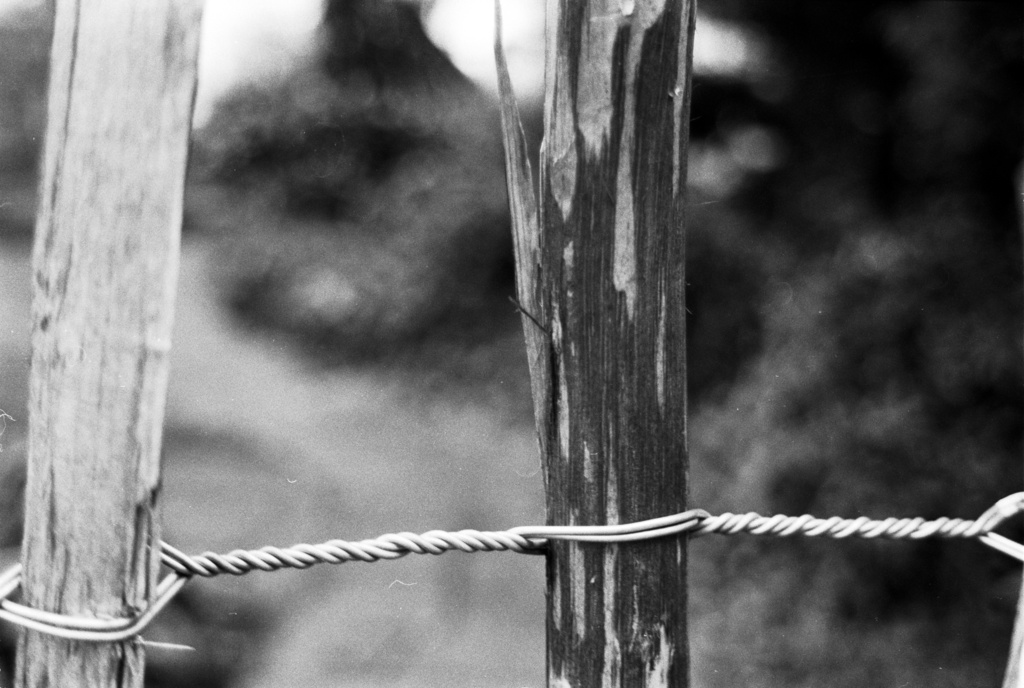
This week I shot another roll of black & white film in my SLR. Last night I developed it, and tonight I’ve scanned and uploaded the highlights for your viewing pleasure. Unfortunately I think I overdeveloped the film a little, so some of the brighter areas are burnt out. Never mind.

First of all, here are a couple of shots taken in Royal Fort Garden. I like the photo of the bench for its woody quality.

And I like this shot of the fence because of the bokeh effect in the background. However, the lighter parts of the fence wire really show that the highlights were overdone in developing.

A day or two later, I went for a walk with Paul in Brandon Hill park. We both took photos of some ducks on a pond. I commented “look at the beautiful shade of green on that duck’s head!” and proceeded to take several photos. Then I realised I only had black & white film. Never mind – Paul’s best duck photo was much better than mine anyway! 🙂

However, while we were there, I did take this picture of the sun glinting through the trees. I like the contrast between the skeletal branches, and the bushy ones.

They say that black & white photos lend themselves to showing textures in detail. I guess it’s because there’s no colour to distract the viewer. But I think this sign, engraved into the pavement and lit by the low sun is a perfect example of strong texture. It makes me want to reach out and touch my screen to see if it’s real. I imagine it might be even more effective when printed.

On top of the world

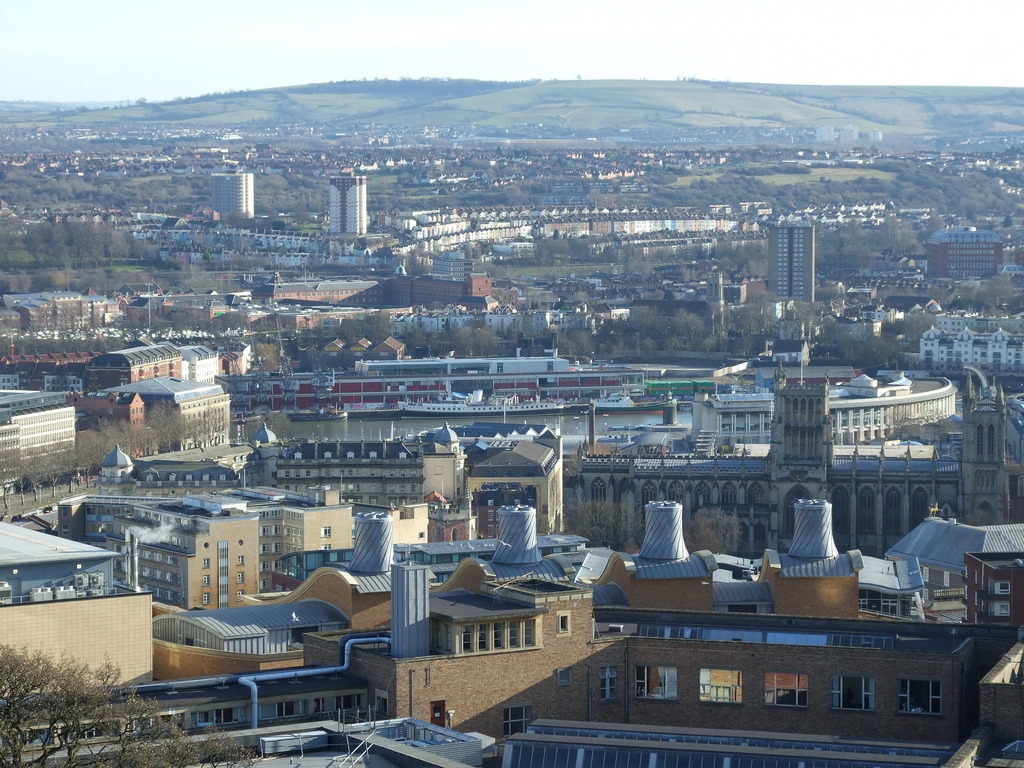
Well, on top of the roof of the Bristol University physics department, which is a pretty tall building on top of a pretty tall hill.

This afternoon I managed to get access to go up there with some colleagues. Unfortunately I’d just finished a roll of film in my SLR, but I managed to borrow a Fuji S6500fd.

The first shot is looking West over the Clifton area. Unfortunately the sun was pretty low in the sky.

This shot is looking East. The tower blocks going across the middle of the photo are in Lawrence Hill, and if you click for the bigger version and look at the pale building on the horizon towards the left, that’s Cossham Hospital in Kingswood.

A little closer to home – this image shows the department of chemistry in the foreground. You can see the the industrial museum about halfway up, by the permanently moored ship on the river.

A crazy idea

As I cycled to work this morning, I had a crazy idea. It’s just daydreaming and will probably never happen, but it’s fun to think about. I’ve already posted this idea to the linux-audio-user mailing list in case anyone there has any insights on synthesising/sampling engine sounds.

I want to measure how fast I’m turning the pedals on my bike (the cadence) and synthesize/sample the sound of an internal combustion engine.

As far as I can work out, there are three major parts to this.

1. A sensor that can measure my cadence. A simple magnet switch that triggers once a revolution won’t be enough to measure the cadence with sufficient resolution, since my cadence is usually between 50 and 80 rpm, and I will need to sample more than once a second. I would probably need to mount multiple magnets spaced equally around the chainwheel and have a single sensor on the frame. Then I have to get it to supply this information to my control program.

2. I need a control program that can read in the input from my cadence sensor and convert a cadence reading of “66 rpm” into a frequency that should be sampled/synthesised, e.g. “500 Hz” (I’m making these numbers up). It will also need to be able to somehow smooth out the readings, perhaps by interpolation, so when I accelerate, the sound of the revs climbing doesn’t increase in obvious steps. It could also have other logic, e.g. when my cadence is 0 rpm, the sound of the engine is idling rather than off.

3. I need a synthesiser or sampler that can take an input from my control program and make the sound of an engine (or more likely, a sine wave to start with). I’ve never sampled or synthesised on a computer before but this engine-specific sampling technology already exists in video games, such as torcs.

I have absolutely no idea why I would want such a device – just for the fun of building it, I guess. I would like it to work in realtime (rather than later generating the soundtrack from recorded cadence data). The thought of sitting at the traffic lights with my earphones in and then hearing the mighty roar of a V8 as I pull away would be really satisfying…

Any thoughts – useful, interesting, humorous, or otherwise – are welcome!