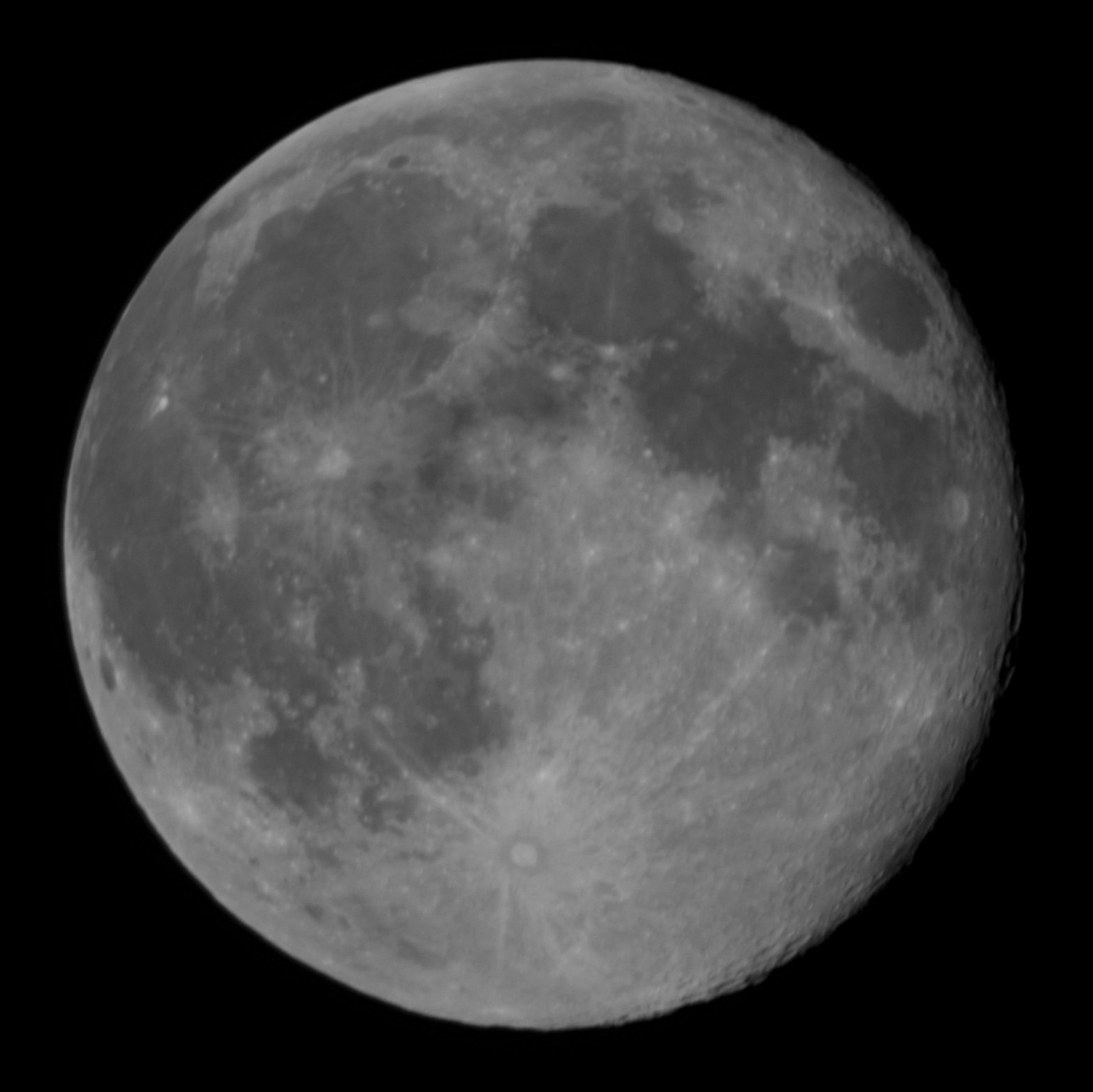
My best moon picture so far

Usually when it’s a clear night and the moon is out, I’ll have a go at photographing it. Last night there was actually a full moon and it was the first clear night in a week or two, so I got snapping.

Technically, this is my best moon picture so far, using a Canon 450D camera, a Tokina RMC 400mm f/5.6 lens and a Vivitar 3× teleconverter – all mounted on a beefy tripod. I shot 5 frames and stacked them using a piece of software called ale. The overall result is that there’s lots of surface detail on the moon.

However, I don’t think it’s my best moon shot compositionally. When lit from the side, the moon’s many craters are well-defined and give a striking impression. Here, hardly any of the craters are visible because the moon is lit from the front. I’ll keep trying!

Trooper’s Hill

Trooper’s Hill today is a nature reserve near the centre of Bristol, in St George. It is steeply hilly and undulating, with rocky outcrops and mini cliffs as a result of mining for coal, copper, clay and slate at various points over the centuries. It is mostly covered with grass and heather and is an excellent oasis of wilderness in the middle of a bustling city.

At the top of the hill there’s a large chimney which apparently used to be a copper smelter back in the 1700s.

Being one of the highest points in the city, there’s a fantastic view southwards, wrapping round from the east over Kingswood, to the west over Clifton. I didn’t have the right equipment with me to make a panorama, but this view is more-or-less southwards over Hanham.

Mainly Dartmoor

When I shoot film, it’s almost always black & white film. Occasionally I shoot colour but until now I’ve had to take it to a lab for processing – which is expensive and inconvenient. Yesterday I developed my own colour film for the first time. It came out pretty well for a first attempt. I wrote about processing colour film at home on my blog, but for now you can enjoy the best of the pictures.

This is an outbuilding at the Two Bridges Hotel on Dartmoor. I was immediately drawn to its mossy roof.

And here is a view of one of the bridges from which the hotel takes its name. The second bridge isn’t nearly so picturesque, so I didn’t bother wasting film on it.

The hotel was probably one of the most remote locations I’ve visited in the UK – it was accessed by a single track road across the moor. On the way home we stopped for a few photos. I’m not sure of the precise location but I like the view.

After we got home, I was in the annoying situation of having a couple of frames left over. I went for a walk in Oldbury Court to see if there was anything that would look good in colour. By the time I got out it was quite dark, so I was forced to use a long exposure. I like the effect it has had on these ducks, pecking at the weir near Snuff Mills.

Processing colour C-41 films at home

Processing black & white film at home is easy. You just need a changing bag to load the film into a tank in darkness, and the rest can be done in the bathroom with the light turned on. The chemicals for black & white are normally used at 20°C but can be used at room temperature if you compensate for the time. You could even pop the chemicals in the microwave for a few seconds.

Many amateur darkroom enthusiasts (until recently, me included) are wary about developing colour film with the C-41 process, on the assumption that it is difficult, confusing, expensive, or all three.

It is true that colour process has to be more accurately temperature-controlled, and that the development should be done at 38°C. Immediately, this conjures up images of having to buy an expensive electronic water bath, such as the Jobo CPE-2. These machines do help, and they do cost hundreds of pounds. However, they’re not necessary. The development usually takes only 3-4 minutes and the later stages do not have to be quite so accurately controlled. This means it’s possible to use a plain warm water bath.

It’s not too expensive or confusing, either. There are beginner’s kits such as the Rollei Digibase C-41 LT20 which include all of the chemicals you need, with instructions. I paid £25 for a kit that can do about 20 films. There are bigger kits which are better value too, and it’s possible to restock on the individual chemicals in future. I’m no expert on the C-41 process, so you should probably read up on C-41 chemistry yourself.

I bought a wallpaper pasting trough for £2 and made a cardboard lid with holes for my bottles and tank to stand in the water. I filled the trough with water at 50°C and stood the bottles and tank in the water to reach the right temperature. The temperature of the water bath fell rapidly at first, and then slowed down. After about 5 minutes the water bath was at about 40°C so I waited until the temperature fell to 38°C, checked the temperature of the developer as well as the water bath, and set the development process going. The thermometer still read 38°C after the development was up.

By the end of the entire process of developing, stopping, bleaching, fixing and stabilising, the temperature of the water bath had fallen to 35°C, but this is still within tolerances.

My message to photographers who are wary of processing colour film at home: don’t be. You have to be careful, but you don’t need any special equipment other than what you’ve already got for your black & white work.

Have fun!
The Railway Children

This week’s Photo Challenge was titled “at the movies“. We had to take a picture that could be captioned by the title of a well-known film. I frantically went through my DVD shelf looking for inspiration and found little. I scoured IMDb’s top 250 and again found myself short of ideas.

Eventually I decided to look at the problem the other way round, to pick a photo I’d like to take, and then to match it to a film. As it was a sunny Sunday afternoon, we headed over to Bitton station on the Avon Valley Railway, where there were lots of families enjoying a ride on the steam train. I waited and watched the train depart and arrive a couple of times until I saw this little girl.

Ladies and gentlemen, I give you The Railway Child(ren).

Canon FTb

Released 1971

The Canon FTb is a pretty ordinary camera as manual-focus 35mm SLRs go. It’s similar to the AE-1 Program that I already have. So why get this one?

The AE-1P is electronically controlled and offers no facility for locking up the mirror. This becomes a problem when I am doing astrophotography, as the vibrations of the mirror are enough to disturb the telescope. The FTb is 100% mechanical, and manually controlled. It’s possible to lift the mirror with a lever and lock it in position so it doesn’t move. Then photos taken with telescopes are vibration-free and very steady.

See all photos taken with the FTb.

Canon FTb

At a glance

Lens Canon FD mount
Film 135
Focus SLR with microprism
Meter CdS with match needle

Sunset with a rainbow in a rain storm

Bit of a mouthful, but the title says it all. This week’s Photo Challenge is to take a picture of a sunset. The weather has been a bit iffy this week, and last night we had a rain storm. But in the middle of the storm, I spotted a glorious sunset and a rainbow. The opportunity was too good to miss, so I grabbed my waterproof camera and ran out.

The Canon Sure Shot A-1 doesn’t haven’t have any manual controls so I was fully at the mercy of whatever the camera thought was best. The pictures are also blurry because of water droplets on the lens, and grainy because I used cheap colour film. The results aren’t great, but here they are anyway.

Underwater camera

Last year I bought a Canon underwater camera for a holiday. Unfortunately the boating lake was too murky to use it, and so it has sat on my shelf ever since.

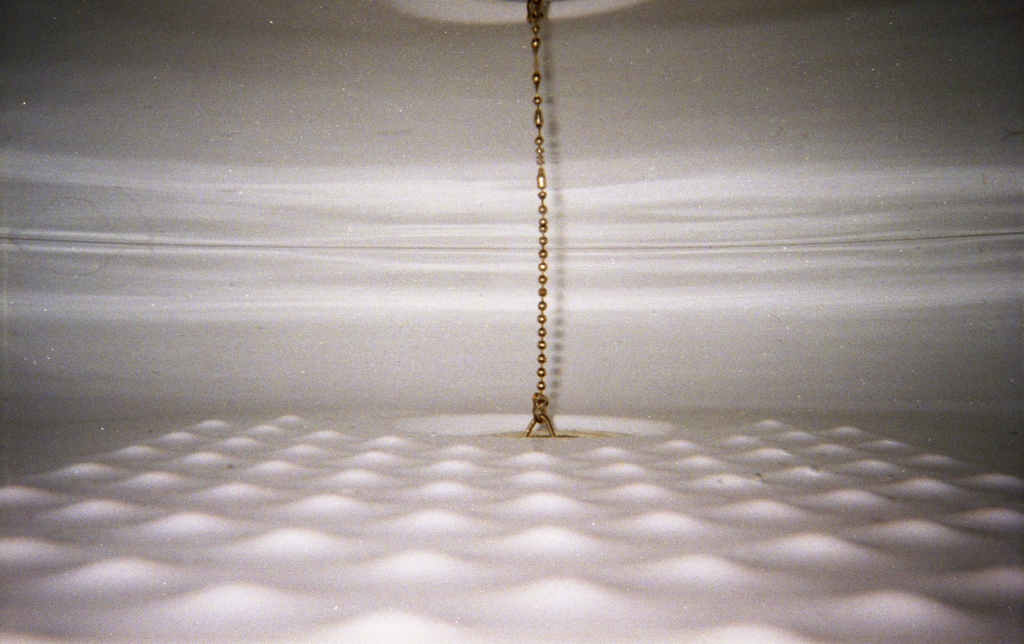
Recently, I decided to mess about with the camera in my bath, and then I set the self-timer and put it in the dishwasher for good measure. So if you’ve ever wondered what the inside of a dishwasher looks like when it’s running – this should help you.

My photo album

Most of my photography these days is analogue – i.e., shot on film, and printed in the darkroom. The only electricity consumed in the entire process is the light bulb in the enlarger. I usually scan the negatives in to have digital copies, so I can post them on my website, but it’s not quite the same.

This week’s Photo Challenge is to take a picture of one of your photos on display, in some form or another. I decided to take a picture of one of my favourite prints. This picture was taken at the Avon Valley Railway in 2010, but the print was made recently, in June 2011. There’s already a scan of the negative on my blog.

This photo shows that I have mounted it in a hardback album and attached a caption label. No matter how easy it is to store, find and view digital photos, they just can’t compare to the experience of looking at printed photographs – especially analogue photographs. I often find myself flicking through this album, and studying the detail in the photos.

Drop me a line if you’d like a traditionally-printed copy of this picture.

Jonathan Gazeley

Geek info: Negative shot on Ilford FP4+ using a Canon AE-1 Program camera with a Canon 135mm f/3.5 lens. Print made on Ilford Warmtone RC paper and toned in Agfa Viradon.