Fishponds Road

In my mind, I conceived standing in the middle of a road junction at night, and taking a long-exposure shot of passing traffic using a fisheye lens, so the traditional streaky light trails would be curved in interesting ways.

I headed over to the junction between Fishponds Road and Downend Road and stood by the front of the Cross Hands pub.

The idea didn’t quite work out as I had hoped. I think I need to be closer to the traffic (not really possible without being run over), or perhaps higher up. Next time I might try standing on the wall for some extra height.

I was also disappointed by the low volume of traffic – surprising for 7pm on a weeknight in a busy part of Bristol. A longer exposure might have helped, but I couldn’t expose for longer than 30 seconds without overexposing. The usual workaround is to use an ND filter, but sadly that’s not possible with a fisheye lens.

Fog and ice

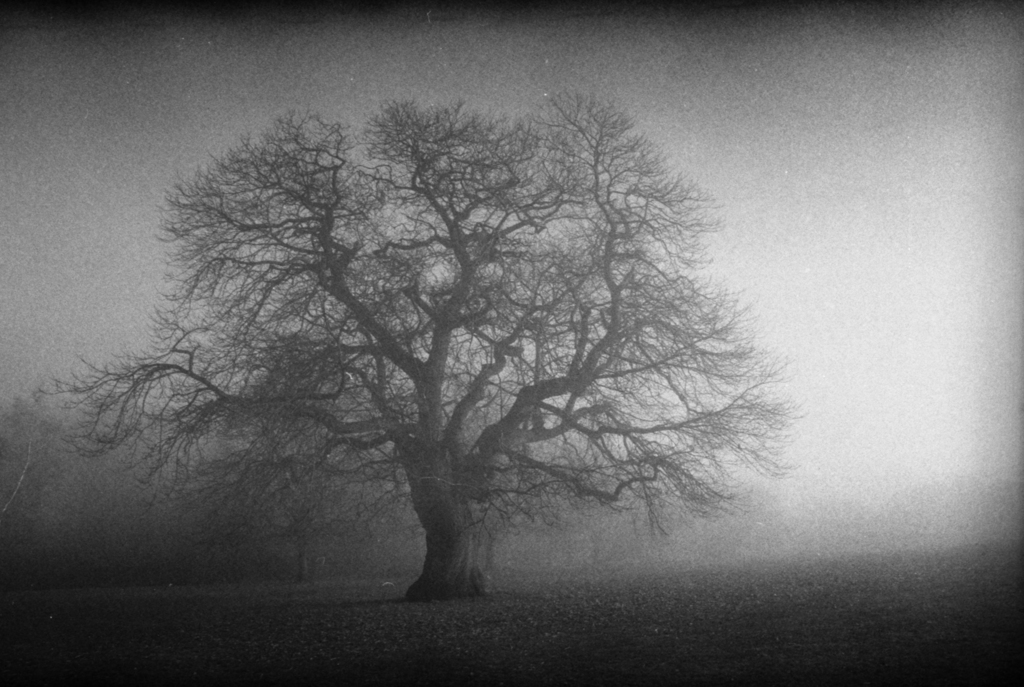
I woke up this morning and looked out of the window. I saw with delight that a thick fog had descended over the entire area. I love fog, so I grabbed one of my cameras and dashed out to Oldbury Court Estate.

On the way, I slipped and fell on ice. Unfortunately, I bruised my knee, hip, head and thumb. Fortunately, the camera that was round my neck wasn’t damaged, despite falling onto the road. After a quick assessment I decided that my injuries would heal without my intervention, and I continued on my photo walk.

I love everything about fog: the way it looks, the way it smells, the way it feels on my face and the way that everything sounds different in the fog. It’s such a mysterious sensation. Past experience tells me that it’s very hard to capture fog on camera. Cameras aren’t as sensitive as eyes, and it’s too easy to end up with a bunch of photos that don’t really look like anything at all. But this time, I’m delighted with the results.

The air wasn’t too cold on my face, but the grass was frosty and lots of twigs on trees had mini icicles on them. I’m not sure which of these next three pictures I prefer, but I expect one will end up on my Christmas cards next year!

Oldbury Court Estate is a beautiful place at the best of times, and especially when it’s frosty and foggy.

Of course, the way it always is with film, there were a few assorted pictures from some time ago on the same roll. Here are my favourites, starting with a pictures of my Conway Camera (Synchronised Model) and a mannequin that lives on my windowsill.

And just in case you needed any extra proof that cats have excellent eyesight, next door’s cat spotted me, upstairs in my house, with a long lens. I bet the cat’s-eye-view has better clarity than this image from my Tamron lens, too!

Misleading statistics

Today, the BBC published a story about the future of broadband, and specifically, 1 gigabit internet.

This isn’t actually so futuristic. It’s not a home connection, but my PC at work has a 1 Gbit internet connection, via the JANET network. It’s had it for a couple of years. When it actually comes down to real-life usage, it isn’t much faster than 100 Mbit or even 10 Mbit. While the data transfer itself does indeed go a lot faster, a lot of time is spent setting up each connection.

Connecting to a server in America from my desk here in the UK takes about 170ms for the signal to get there and back. It will take a few back-and-forths before your file transfer begins. The BBC published a table with some typical values in it.

How quick is a 1GB connection?
1 Gbit 2 Mbit
Download Tolstoy’s War and Peace 0.002 secs 1 sec
Download a 45-minute album 0.05 secs 26 secs
Download a 90-minute HD film 3 mins 36 secs 30 hrs
Watch 1-minute of Super HD 6 mins 40 secs 200 hrs

If, after reading that, you are expecting to use your 1 Gbit connection to download War and Peace in just 2 milliseconds, you can think again. There are several steps your computer has to do to initiate the connection. Each one is subject to the latency, and will probably take a few hundred milliseconds. That’s hundreds of times longer than it actually takes to transfer the data. Obviously the larger the file, the less significant this is. Wasting one second out of nearly 7 minutes for the Super HD video isn’t so bad.

For those who think that latency will improve with speed, think again. There may be some technological advances that shave off the odd millisecond here and there, but unfortunately there’s a pesky thing called the speed of light. The speed of electricity or light in a cable maxes out at 186,000 miles per second, and will usually be about two-thirds of that value, depending on the cable. It will take light 134 milliseconds to go round the equator once. Give or take, that’s how far it is from the UK to Australia and back, and in that time, according to the BBC, you could have downloaded War and Peace 67 times.

As of today, while my computer can send and receive data from the internet at 1 gigabit, unfortunately its hard disk is much slower. Downloading large files tops out at around 350 megabits because the hard disk just can’t handle it. Of course, better and faster hard disks will be invented in the future so this is a non-issue in the long term.

All I’m saying is – don’t believe everything you read in the news, and be aware that for most applications, 1 Gbit is not ten times faster than 100 Mbit.

That is all 🙂

To other darkroom beginners

This is a quick post to share a useful resource I discovered online.

I’m a relative beginner in the darkroom, and occasionally I find that my negatives don’t come out perfectly. It can be hard to know why, what you did wrong, and how you can avoid the same mistake in future.

Fortunately, Olympus have a website about photomicrography which includes pictures of commonly-made black & white film processing errors.

It’s already proven useful to me, since a film that I thought had been fogged by stray light, I now know was caused by expired fixer. The new fixer is already in the post.

Student day of Action

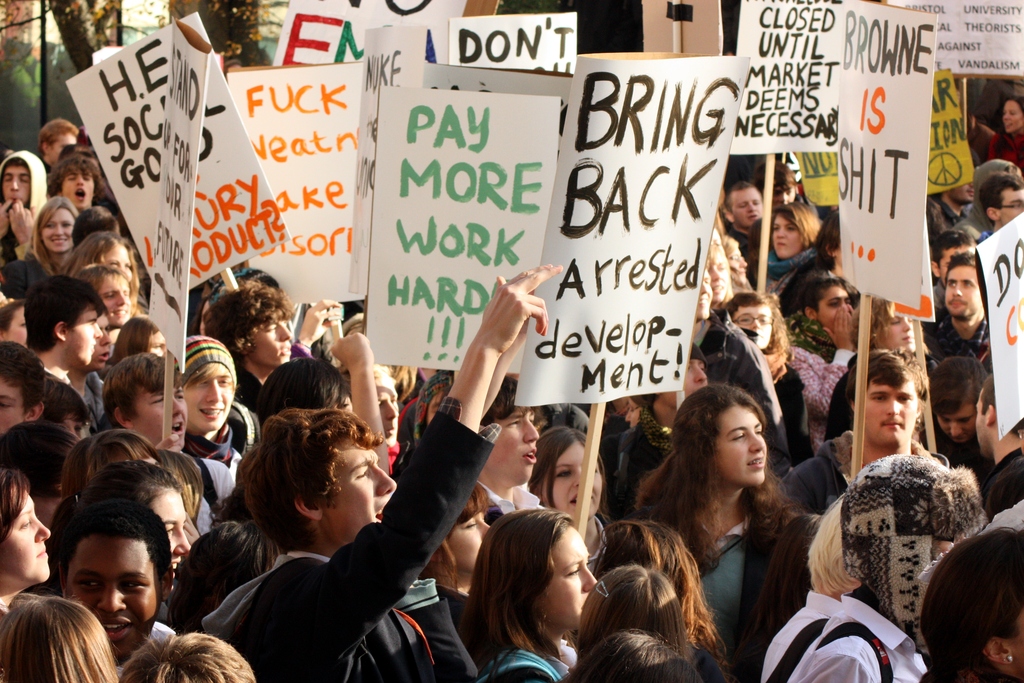
Today, students across the UK protested against cuts to education funding, and an increase in tuition fees. I’ve got mixed opinions on the subject that I won’t go into here, but I decided to follow the rally and the march to see if there were any good photos to be had.

The initial rally was in good spirits. Many students had made amusing banners that had little or nothing to do with the protest.

The rally outside Senate House finished, and the procession of around 2,000 people headed down past the Wills Memorial Building, and down Park Street towards College Green. There was a large police presence to prevent the protest from interfering with major roads and businesses in the centre of the city.

Having bounced off the police, and finding that there was nothing to do, the protest turned back up Park Street and congregated outside the Wills Memorial Building. The tone of the protest changed a little, and a few troublemakers shouted abuse at police, and three or four fireworks were let off in the crowd.

Combining this with the facts that my camera battery had run flat after 450 photos, and that I didn’t really care for the motion of the protest, I went back to my office.

And for those unfamiliar with Bristol, here’s a map to show the three locations I mentioned.

[mappress mapid=”2″]

Heavenly bodies

No, sorry. This is another post about astronomy. What were you expecting?* 😉

I wrote recently about my new fisheye lens. But finding out that their original name was whole-sky lenses inspired me to have another go at making star trails with this lens. It took about three hours to expose.

I also took a much shorter photo to show the moon – which is much, much brighter than the stars. You can’t easily get both in the same picture at the same time.

After writing a scathing review of my 500mm mirror lens the other day, I decided to have another go with mine. I got much better-exposed results this time, but focussing it is still extremely difficult. This is the best I managed – so overall I’m not impressed.

* Although, in year 7 physics we did watch a video of the same name, also about astronomy. I’m sure you can imagine the hilarity among a group of 11-year-old boys.

A visit to the Eden Project

This weekend, Hannah and I went to visit the Eden Project. I went when it first opened (but was not yet completed), so it was hugely different this time. There’s a reasonably predictable selection of flowers and plants here, as well as some photos of the waterfalls.

I don’t know what any of these plants are called, so I’m not going to attempt to name them!

For some reason, there was a chessboard set up in a clearing in the jungle.

There are a few waterfalls around the tropical biome (or it might be different parts of the same one – it’s hard to tell).

New in the tropical biome this year, there’s a viewing platform called the rainforest lookout. It’s rather high up, with a see-through floor of metal mesh, and suspended from cables. The tropical biome is already rather hot and humid, and it only gets worse as you get nearer the top.

I think this picture could almost be the Amazon rainforest.

This view include a hot air balloon, which is used by scientists and gardeners to fly around the biome and inspect and maintain the canopy of the trees.

Last but not least, these sculptures in the Mediterranean biome were somewhat terrifying.

I did, of course, take a few photos of the famous exterior view of the biomes. Unfortunately the weather was very grey and overcast, and the photos just don’t look pretty. I’ve faked a bit of colour back into this panorama, but it looks more like Teletubby Land.

Mirror lenses: worth it?

A few weeks ago I attempted to take some photos of the moon with my 300mm lens. The results were pretty good, but I wanted more, more, more! At 300mm, the moon is still quite small in the frame, and the photo I just linked was cropped a fair bit to “zoom in” some more.

The trouble is, telephoto lenses are expensive. I looked at various options and eventually got an excellent deal on an Opteka 500mm f/8 mirror lens.

Opteka 500mm f/8 mirror lens

Using a lens with a focal length of 500mm (or 1000mm with supplied teleconverter) was never going to be easy. At such a huge zoom, the tripod needs to be rock-steady, otherwise the image will move all over the place.

The Opteka 500mm lens was manual focus, like most (all?) mirror lenses. In principle this didn’t bother me, since I frequently use manual-focus Canon FD lenses. But in touching the barrel of lens, no matter how lightly, you send the moon ricocheting wildly around the viewfinder. You have to wait ten seconds for it to stop wobbling to see if your focus adjustment was any good.

Which brings me onto my next point. The focus ring is extremely sensitive. Even for an infinitely-distant object such as the moon, moving the focus ring just a millimetre sends the image to a blur. It’s a bit like using a rangefinder – when not perfectly focussed, there are two ghost images that slide past each other as you adjust the focus. I never managed to make them line up properly with this lens because it was too sensitive.

After an hour with the lens and camera on a tripod, I hadn’t managed to get a well-focussed picture of the moon. And in cases where I had got the focus not too far off, the general image sharpness was terrible, and there was considerable chromatic aberration. The following image is the best I got out of the mirror lens in an hour of shooting.

The moon

That could have been a really nice image, as the moon almost fills the frame.

I won’t give up just yet, but I’m reasonably confident that I won’t be able to improve on that picture. I might do better to buy a Canon 2× teleconverter to make my 300mm lens into a 600mm. I guess the L-series glass is a little out of my league for the time being 😦

So, to answer the question in the title…

No. Mirror lenses are not worth it.

Apple’s swear box

I recently noticed when using my iPhone that Apple have some sort of a list of swear words in their spelling dictionary.

For those unfamiliar with the way text input works on the iPhone, if you make a typo (or enter a word not in the dictionary) then one of these happens:

  • If the word you typed is similar to a dictionary word, the iPhone autocorrects it to the dictionary word
  • If the word you typed is not similar to a dictionary word (or you reject the suggested autocorrect) then it just gets underlined in red

I know there’s a “swearword list” because if I type a word very similar to a swearword (e.g. fick instead of fuck) then no autocorrect suggestion is made.  This would suggest that the dictionary doesn’t include the word fuck.

But when you directly type fuck, it is not underlined in red – so it exists in the dictionary! We conclude that there’s a special list of words regarded as swearwords which the phone will accept when given directly, but will not autocorrect anything else to.

I would love to see this list, and to find out what Steve Jobs regards as rude and inappropriate 😀

St Paul’s Church

Some time ago, back in 2001, I set up the first website for St Paul’s Church, Stockingford.

There have been a few iterations since then, but today I’m pleased to announce the latest edition.

It has been fully redesigned to include more dynamic elements, provide more useful information, and require less maintenance. It’s based on WordPress, so we (my Dad and I) no longer have to edit static HTML and mess about with FTP.

As before, the website is kindly hosted by Ridgeon Network.