Andromeda Galaxy

Some time ago I got a new telescope – a Celestron 130EQ-MD Newtonian rather than a Celestron NexStar 127 SLT Cassegrain-Maksutov formula. In short, it is more sensitive to light but sacrifices magnification. It’s perfect for deep-space observation like nebulae and galaxies, while the Maksutov is better for observing planets which are much brighter and smaller in the sky. Unfortunately, I found that my Canon DSLR was not able to focus to infinity on the Newtonian so I haven’t been able to take any pictures with it – only observe by eye. That changed when I modified the eyepiece holder to be able to screw further into the optical tube of the telescope, moving the camera closer to the secondary mirror. I also purchased an all-in-one 1.25″ eyepiece to Canon EOS adapter, rather than going down the usual route of using a T-ring and adapter. This also saved a few millimetres. Having demonstrated that I could now focus the telescope and camera to infinity, I collimated it using an inexpensive laser collimator, and got ready to take it to my favourite dark site in Somerset. It wasn’t all that dark as it was a 98% full moon. I wasn’t expecting to take great photos of deep-sky objects but I wanted to have a go with the telescope anyway and familiarise myself with it – the results of the photography were not so important. I started off with a customary photo of the moon which shows that the telescope is doing pretty well at resolving detail, despite having a shorter focal length than the Maksutov.

Full moon
Full moon

Then onto the real deal for the evening. Many of the brighter Messier objects were either too near the horizon, or below it altogether, or near the moon. Of the ones that were easily visible on a not-very-dark night, I chose the Andromeda Galaxy, Messier 31.

Andromeda Galaxy
Andromeda Galaxy

This is a stack of about 40 pictures. It isn’t a great photo because I was limited to taking exposures no longer than three seconds each, as my motorised alt-azimuth mount has a really annoying stepping motor that causes motion blur every time it steps. I do also have a continuously driven German equatorial mount and next time I shall use that, and hopefully be able to exposure for much longer in each shot. But still, it is a promising first attempt at photography with a Newtonian telescope and I’ll be back out in Somerset the next time there’s a clear night.

Before heading home, I also took a few frames of Caldwell 14, which is a double star cluster. The focus isn’t quite right but otherwise it seems to have come out quite nicely. Again, longer exposures are ideally needed.

Caldwell 14
Caldwell 14

Art photographer

Ever since I tried my hand at sort-of-abstract fine art photography, I fancied dressing as a 1960s art photographer. I’ve had the idea of taking a self-portrait like this for ages, but I only just had the motivation to try it as this week’s Photo Challenge is to take a self portrait.

Self portrait
Self portrait

Taking self portraits is hard and the lighting here is bad. In the end I got fed up of running to and from the camera so I decided to call it a night. I hope to revisit the idea at some point when I have more enthusiasm and a willing volunteer to help. After all, that beret was Β£2 and I want to get my money’s worth!

I was trying to pull off the look of “1960s New York art photographer” (think along the lines of John Lennon) but I think it looks more like a stereotypical Frenchman – probably not helped by my Gallic shrug. I was trying to look like a bossy photographer shouting at a model! Perhaps my T-shirt should have been tighter, and tucked into high-waisted jeans. Oh well – the T shirt was only Β£3 from Primark and I’m sure I’ll get the wear out of it. The specs were crappy reading glasses from Poundland that I popped the lenses out of, and painted black.

The most expensive part of the costume by far is the gorgeous Mamiya C220 twin-lens reflex camera. It’s not a prop either – it’s a fully working and much-loved camera which I recently used to take pictures at a friend’s wedding πŸ™‚

Bristol Balloon Fiesta Night Glow

The Bristol Balloon Fiesta is taking place at the moment. I’m not really one for crowds, so last night instead of heading over to Ashton Court to see the festival, I drove to a top-secret location just south of Bristol, on top of a hill which overlooks the city. Armed with a pair of binoculars and a telephoto lens, I photographed the night glow and fireworks from afar.

The first photo, taken shortly before sunset shows the surroundings. I was about four miles from the fiesta at Ashton Court. In the background you can see the Second Severn Crossing, which is about 12 miles away.

When it got dark, the night glow started. It took about quarter of an hour of the balloons flashing, but I’ve decided to publish only one picture, because through the lens of the camera all the photos came out remarkably similarly. If you want to see what it was like, I also shot a couple of minutes of video which is below the image gallery.

After the night glow finished, there was an impressive round of fireworks. Just as it concluded, the rain started and we scurried back to the car. A good night out.

Candid shots

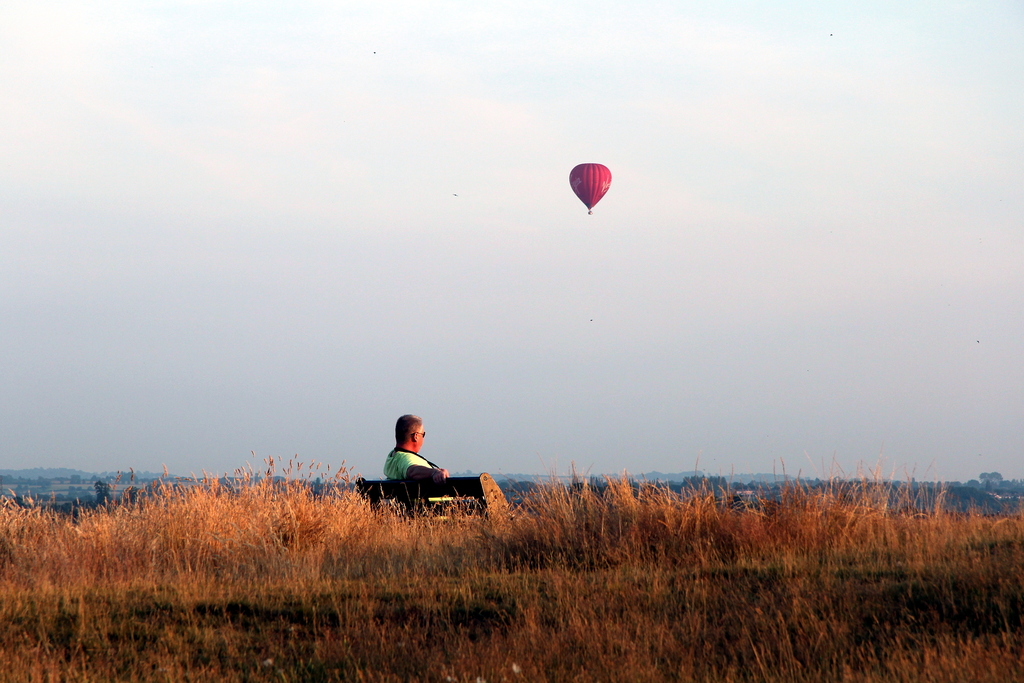
People photography isn’t something I do very often – and when I do, it’s usually in a studio setting with a (mostly) fully aware subject. But this week’s Photo Challenge was to take candid shots of people, so I decided to head up Troopers’ Hill in the late evening. I managed to catch a glorious display on one of the sunny days last week, with the golden sun low in the sky and a summer haze hanging over the city. I was expecting to find a few dog walkers but I was spoilt for choice with people going for an evening stroll or sitting on benches.

OK, so two of those pictures don’t contain any people – I like them anyway. For my Photo Challenge entry, I think I’ve ruled out the two girls sitting on the bench as the composition is mostly uninteresting. I like the dynamism of the hot air balloon passing over, and the man of the couple pointing towards the hazy city. I’ll probably choose the hot air balloon, because it is unusual. Anyone have any thoughts?

False colour

A while back I came into a roll of film that expired in 1992. It was Kodak Ektar 125, discontinued in 1991, but famous for its saturated colours. I kept it aside and waited for sunny weather that would make the most of the colours.

Eventually, I decided to shoot the film in an old camera – A VoigtlΓ€nder Vito II that once belonged to my grandfather, and was used to document the aftermath of the Korean war in the mid 1950s. The camera still works perfectly, although the light seals appear to be worn and it is leaking light. I should probably fix that before I use the camera again.

I exposed the film at ISO 50 rather than the rated ISO 125, to compensate for the loss of speed that is expected with age. It still came out a bit underexposed and I could probably have done with exposing it at ISO 25. The film has exhibited a green/blue cast andΒ massive colour shifts which seem to depend on the total exposure received by that negative.

Nonetheless, the pictures are quirky and unusual, and I’m quite pleased with some of these. No post-processing apart from fixing the underexposure!

Avoid “Pedal Bikes” in Bristol!

As a commuting cyclist, I rack up quite a few city miles on two wheels each year, and I make sure I get my bike serviced at least once a year. For years I’ve used Pembury Cycles on Gloucester Road (even though it is nowhere near my current home or workplace, I used to live nearby some time ago). Sadly, the Gloucester Road branch of Pembury closed (although the Bishopworth one remains open), so since then I’ve been looking for a new bike mechanic either near my office in Clifton, or near my home in St George / Hanham.Β There’s a relatively new startup in St George called Pedal. It’s on my route into work so I decided to give it a go.

On Saturday, I went into the shop to book a service for the following Monday, and they said bookings were not necessary, just turn up and they can do the service same-day. The chap in the shop was surly and unhelpful but I gave him the benefit of the doubt and booked the bike in anyway.

On Monday, I returned with the bike. He said they were too busy and wouldn’t even be able to look at it until Tuesday. I grumbled and said they must have it done by 5pm on Tuesday so I could collect it after work. He promised to ring me during the day on Tuesday to let me know what work needed doing and to confirm it would be available.

On Tuesday, he failed to call me so from 3pm onwards I tried to ring to find out what was going on. The number on their Facebook page always rang out and went to voicemail. Their website had a different number, which repeatedly offered the busy tone. After about a dozen tries, and getting on for 4pm, I got through to the bloke who said they hadn’t even started the service yet. I asked that they begin immediately so I could pick it up by 6pm. He said he’d get onto the mechanic, who would ring me back to confirm. Half an hour passed, and no word from the mechanic so I rang the shop again. He said he would get the mechanic to stay late and have it ready for me although it would probably be Wednesday morning. I said that wasn’t good enough and it had to be Tuesday night. He agreed, and I said I would return to the shop in St George after work. At about 6pm, I arrived at the shop. The guy seemed surprised to see me and admitted that they still hadn’t started work on my bike. I said to forget the work, I just wanted my bike back in whatever state. He said it was no longer in the shop, but had been taken to premises in Stokes Croft so I couldn’t have it back. I demanded it back and said I’d drive there myself to get it, and I didn’t care if the work had been done or not. I arranged to go and fetch the bike at 8pm.

8pm, Stokes Croft. They appeared to have serviced the bike, and done a rush job between 6 and 8pm (predictably). However, they’d cleaned it (which is more than I expected) and seemed to have done an OK job in general. I was dealt with by the mechanic, although the shop guy from St George was there too, standing in the background and ignoring me. I asked for a discount for the inconvenience and the mechanic agreed, and gave some money off the servicing and free brake pads. I took the bike home but didn’t get a chance to ride it for a couple of days.

Two days later, when I first rode the bike, I was infuriated at the bad job they’d done. I had to stop three times on the way to work, and on the first stop I returned home to pick up some tools to see me through the rest of my journey. Here’s a catalogue of mechanical problems introduced by the shop:

  • One brake was adjusted; nice and tight with the quick bite, while the other had received no attention and was still loose. It was difficult to brake evenly and safely with two radically differently-configured brakes.
  • Gears no longer changed down properly (they used to before the service) and instead they rattle for a few seconds before changing. I can’t even change down into the hill-climbing gear any more.
  • Gears are slower to change up, too. The chain slackens for a second while changing, which it never used to do.
  • The bottom bracket was disassembled for cleaning and lubrication, as I would expect. However, now there’s something wrong with the bearings and they clunk as I pedal.
  • Both tyres were soft when the bike was returned to me, and needed quite a lot of pumping.
  • The front tyre has received an impact from a sharp object (possibly while being transported to Stokes Croft) which has torn some of the tread off the canvas and made a bulge in the sidewall.
  • The saddle was put back at the wrong height. Not a showstopper, but basic courtesy and something I’d expect a competent bike mechanic to do.

In summary, I am never going back there again, and I recommend you avoid them too (unless you want them to charge you for breaking your bike and to be rude about it). They’re a newish startup so you expect one or two teething problems as they find a workflow, and I was prepared to be tolerant. But they’ve done a really terrible job on the mechanics side and an even worse job on basic customer service, by repeatedly breaking promises and failing to provide information, and general lack of politeness. I think this is an endemic problem in the staff they have – they just didn’t care about the customer. Given that I went into the shop wanting to spend money, they didn’t really encourage me to do so.

Avoid Pedal Bikes in St George, Bristol.

Twycross Zoo

Hannah and I went to Twycross Zoo this week. Apparently they have the largest collection of monkeys and apes in the western world! Unfortunately I didn’t pay enough notice to the plaques so I’m not sure what all of these animals are 😦

I’ve tried wildlife photography before at Bristol Zoo and at Longleat Safari Park but this time I was particularly pleased with the results. We went to the zoo on a weekday during the school term, so the zoo was very quiet and most of the other visitors were adults who were content to stand quietly and watch the animals behave naturally, rather than thumping on the glass. The animals seemed more co-operative and with fewer people jostling for position at each window, I was able to take my time watching each animal, to note its behaviour and take a picture of it interacting with its environment rather than a quick snapshot while it is just sitting still.

It was also the first time I have used my recently-acquired Sigma 100-300mm telephoto lens for wildlife. Its previous outing was landscape photography on a tripod at Dundry. The lens is significantly better quality than the Tamron 70-300mm lens that it replaced, but the comparison isn’t just about the optical quality of the glass. At 300mm, the Sigma has an extra stop of light so the camera is better able to make metering and autofocus decisions. The Sigma also has ultrasonic focus motors so once the camera has decided how to focus, the lens actuates very quickly, meaning you lose far fewer shots of moving objects. I did note, however, that the Sigma lens weighs a ton and is difficult to hand-hold. I was glad of my monopod!

I’ll be taking this lens and the lessons I learned at Twycross to Longleat for our honeymoon, where we have booked a private Land Rover and our own guide to show us around πŸ˜€

Objet d’art

On Sunday I had a strong desire to head out into Somerset and photograph some more churches and other old structures. I always enjoy photographing buildings in rural settings and I’ve now got quite a collection of churches such as the beautiful church of St Etheldreda in West Quantoxhead. For a while I’ve been thinking of making a more determined effort to photograph churches in the region and hand-print a book with the best photos. On Saturday I also learned that the Somerset towers are actually a thing and that I am not the first person to notice the beauty of churches in the south-west. This has bolstered my determination to photograph the most attractive churches.

However, snapping back to reality for a minute, Sunday was the final day of the Glastonbury festival, and I decided it would probably be a bad idea to head into Somerset and get snarled up in the south-west’s largest traffic jam with almost 20,000 hippies – and worse, teenagers.

Not wanting to waste my photographic inspiration, I decided to set up a tabletop studio in my house. This week’s Photo Challenge is the third week of “sensory month” and the challenge is to explore the sense of touch. I prowled around the house and garden, looking for objects with an interesting texture, and happened upon a rough piece of wood with rusty nails from a broken fence. I decided to photograph it in a low-key fine art style (mostly dark background), as this isn’t an area I have explored much in the past. Almost all of my macro and “tabletop” photography has been high-key (mostly white background) and I really do need to get in more practice with setting up artificial lighting.

Rough wood
Rough wood

I deliberately aimed for a bold composition, using a totally black background to emphasize the rough grain of the wood. I think the effect has worked, and I can imagine reaching out and touching it, and getting a splinter.Β You can get a sense of the shallow depth of field by looking at the nails, which are out of focus.

Having gone to the effort of setting up the backdrop and the flashgun and assembling one of my more outlandish cameras, I decided to make the most of it. I shot several more pictures in this style, and this is my favourite. It’s a picture of one of my prettier cameras, a Mamiya C220, which I recently used to shoot the pictures for Infrared Week.

Mamiya C220
Mamiya C220

The picture was shot on medium format black & white film (Ilford FP4+) using aΒ Mamiya RB67Β studio camera with a Sekor C 127mmΒ f/3.8 lens, stopped down toΒ f/4.5. Shutter speed was set to 1/250 to control the ambient light, and the leaf shutter was synced with a single flashgun armed with aΒ snootΒ to avoid any light falling onto the black backdrop.

Setup shot
Setup shot

The view from Dundry

Recently my friend and colleague David (who knows South Bristol a lot better than I do) recommend I head up to Dundry for a great view of Bristol. Dundry is a small village several miles South from Bristol, and perched atop a large hill. It has several radio masts and I believe one of them broadcasts BBC Radio Bristol.

This was also the first proper outing with my Sigma 100-300mm f/4 telephoto lens, which was an upgrade from a Tamron 70-300mm f/4-5.6. I’m delighted to say it’s in a different league – amazing. There is basically no chromatic aberration at all, which was one of the major flaws of the Tamron lens. The limiting factor I ran into was the haze of a hot Summer’s day, and the heat shimmer from shooting over a city.

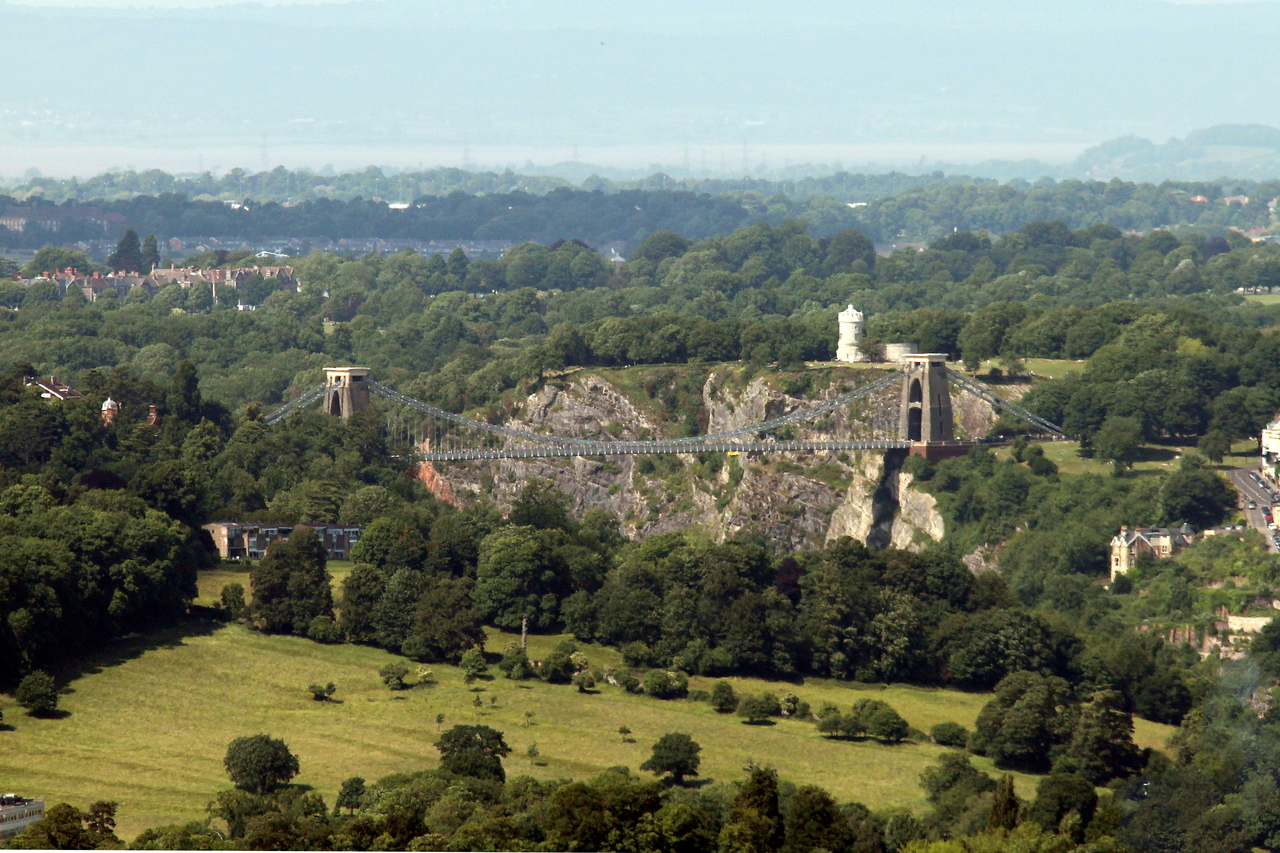
One of the most prominent features on Bristol’s skyline is Brunel‘s famous Clifton Suspension Bridge – glorious in the sunlight. The small white tower just behind the bridge is the Clifton Observatory. The Avon Gorge traditionally marks the county border between Somerset (on the left) and Avon (on the right) although the county of Avon no longer exists, and is now the City of Bristol.

Clifton Suspension Bridge

The sun was darting in and out from the clouds so some of these images have a bluish cast in certain parts that were under cloud at the time. This next image shows the high rise central area of Bristol. The tallest building you can see is Castlemead. On the very left of the picture you can see the Purdown comms tower, on the right you can see the wide blue and yellow Ikea building, and up a bit from Ikea is the distinctive Dower House, more commonly known as “the yellow castle near the M32”.

Central Bristol
Central Bristol

This picture, centred on the University of Bristol, is panned a bit left of the one above. There are so many buildings in such a small area that it’s hard to describe the picture in words, but I’ll try anyway. From left to right:

  • To the let of the green park area, the building with the steep roof and green bell tower is the great hall of Bristol Grammar school
  • At the top of the green park area you can see Cabot Tower
  • Immediately overlapping Cabot Tower is the blocky Senate House, the University administration building
  • The Gothic tower is the Wills Memorial Building, home to the law and geology departments
  • The tower with the four turrets is the H H Wills Physics laboratory
  • Between Physics and the white chimney you can see the construction site for what will be the Life Sciences building which should be open for use in 2014
  • The white chimney belongs to the veterinary school on Southwell Street
  • Immediately below the chiney, the two-tone sandy building is the Queen’s Building which houses most of the engineering faculty
  • Just right of the Queen’s Building there are two similarly-coloured orange buildings. The one closer to us is the Chemistry department, and the one further away is the Medical faculty. The Chemistry department also owns the pale buildings to the right.
  • All of the buildings along the bottom of the picture are apartments on the floating harbour
  • That’s more bullet points than I had expected to write. Maybe I should just have annotated the picture. Ho hum.
University of Bristol

Probably of relevance only to people who live in mostly-low-rise East Bristol, the green area is Troopers Hill Nature Reserve. It has a wonky chimney dating back to the 1700s when the area was quarried for coal, clay and copper. The steep terrace of houses immediately to the right of the nature reserve is Troopers Hill Road. The only distinctive building you can see in this picture is the domed clock tower of Cossham Hospital, Kingswood, visible in the top-left of this picture.

Troopers Hill
Troopers Hill

Whilst I was at Dundry I walked along a public footpath in a field which had some cows in it. I thought they deserved a photo, but decided not to get too close after our comically disastrous trip to Gloucester last year.

Cow
Cow
Cow
Cow

This buttercup was also photographed with the Sigma 100-300mm lens. It doesn’t have a macro setting so the picture was taken from about three metres away. The sunlight was bright enough that I was able to keep the shutter speed fast and shoot this hand-held!

Buttercup
Buttercup

I hadn’t realised how close Dundry is to Bristol Airport until a plane went over quite low. I like aeroplanes but I can’t tell you what kind this is. It’s orange and white, and it was coming in to land.

Easyjet plane coming in to land

Halls of residence

The other day, in my role as a member of university IT staff, I visited a hall of residence to install some wireless networking equipment. It’s out of term-time so the hall was unoccupied, and Chris and I had the building to ourselves. It was quite eerie Β -a building normally full of people and noise standing silent. In one room, there stood rows of pillows and bedding, individually bagged and ready to be placed in the bedrooms in time for the new academic year in September.

Bedding
Bedding

In another room, there was a long table full of desk lamps, also awaiting deployment to their future owners. It reminded me of a forlorn group of outcasts who didn’t make the cut for the Pixar advert.

Lamps
Lamps

There were other rooms with objects neatly laid out that I didn’t photograph – for example a room with a dozen sets of cleaners’ buckets, cloths and chemicals, and piles upon piles of mattresses and tables in the great hall.

One or two of the rooms on the higher floors had balconies, from which I captured these pictures of the Clifton area of Bristol.

Clifton
Clifton
Clifton
Clifton

Our business at this property was to install wireless access points and associated cabling. The wiring cabinets for the building are in the roofspace. I hadn’t been up there before and was delighted to find that the roofspace is segmented into compartments divided by heavy, iron fire doors, each about three feet tall, and with narrow crawling boards to navigate across the fragile floor.

East Wing roofspace
East Wing roofspace

In the East Wing, the wiring cabinet was in the first compartment so there was no need to venture far into the swelteringly hot loft. However, in the West Wing the cabinet was in the ninth compartment. Fortunately, somebody thoughtful had installed some proper walkways with handrails. Nonetheless, it was still hot up there, and the low doors and low beams meant walking in a continuous stoop, stopping every few paces to wrench open the tightly sealed iron doors.

West Wing roofspace
West Wing roofspace

My reward? Lacing up a wiring cabinet. White cables supply the wired network sockets in the students’ bedrooms while yellow cables supply the wireless access points that cover the entire building. All in all, a job well done and a welcome break from my usual job of wrangling with Linux systems at my desk πŸ™‚

Wiring cabinet
Wiring cabinet