
It’s my birthday today, and Hannah bought me a Whittard of Chelsea coffee grinder. Needless to say, it grinds up beans and makes good coffee, but I also like the look of it. The base reminds me of a plinth that a statue might stand upon.

It’s my birthday today, and Hannah bought me a Whittard of Chelsea coffee grinder. Needless to say, it grinds up beans and makes good coffee, but I also like the look of it. The base reminds me of a plinth that a statue might stand upon.
All this talk about the cold snap recently reminded me of my visit to Geneva in February 2003. I saw some spectacular ice around the edge of the lake that weekend.
These were scanned from 35mm negatives, taken with a disposable camera. Not bad, considering!


I shot a roll of black and white film over two snowy days on the 6th and 7th of January, 2010.
I wasn’t sure how it would come out, given that black and white film can only “see” the colours black and white, and the snow is white. As it turns out, I’m very pleased. Anything that’s not snow appears as black, and the contrast is striking. I think it’s right what they say about black and white photos showing more texture. I will definitely be using black and white for snowy scenes in future!
This is the snow sitting on my balcony railing. I love the texture.

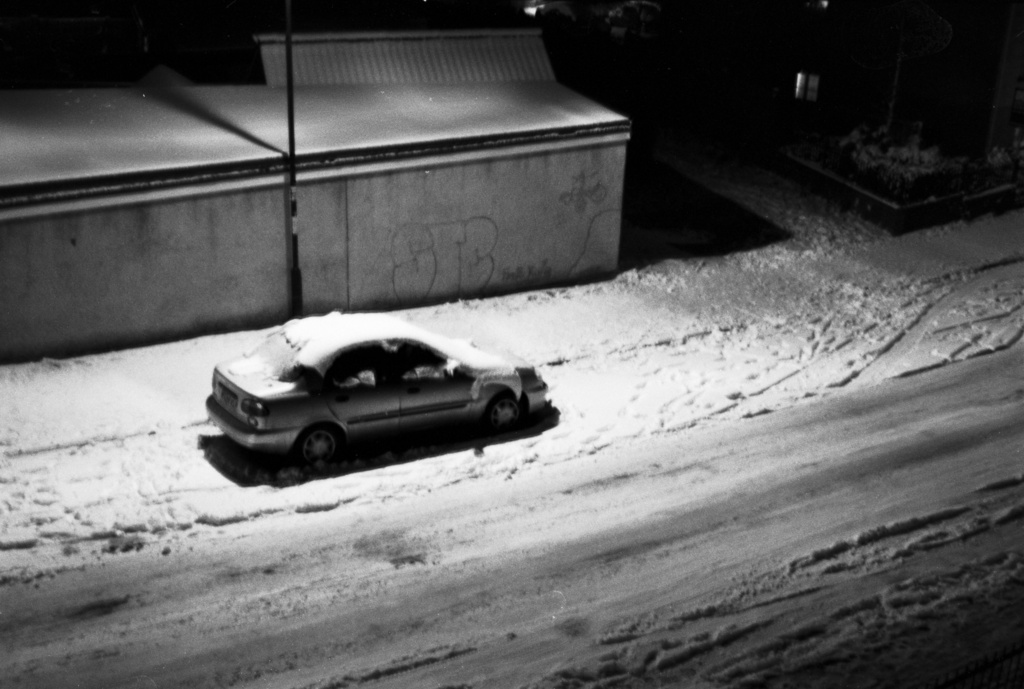
This is a snowy car on the street outside my flat at night. I like the way the street light deepens the shadows in the tyre tracks.

Some students walk through the archway of the Royal Fort gatehouse on their way to lectures.

Some students built a huge snowman in Royal Fort Gardens. It must have been about ten feet tall, but when I visited it a day later it had started to lean.

This snow was sitting on the branch of a tree outside the physics building.

I recently built a pinhole lens for my 35mm SLR. I took some photos over Christmas and I just got the film back from the developers.
The results are good, given that this “lens” is a piece of tin foil with a hole in it. The focus is pretty good, although not perfect. The bigger defect is that most of the pictures are over-exposed, because my estimations must have been wrong. I’ve managed to largely correct the exposure on the computer.
Here are my favourites from the roll. To start, we have a picture of a bare light bulb.

A view of Clifton Triangle, Bristol. This is a bit like one I’ve taken before, although that was with a normal, sensible and boring lens.

And finally a view from my bedroom window at my parents’ house in Nuneaton. There was a little snow, but sadly not enough to do anything fun with other than admire for about ten minutes. I think the yellow spot is where the sun was, and I’m putting its colour down to a developing anomaly.

Some water gathered and froze in a canvas furniture cover. The block of ice was too heavy and too slippery to lift, so naturally my brother and I smashed it.
And here’s a close-up of the end result.

Some years ago, my dad bought me a book about electronics, computers and robots from a jumble sale for 10p. It was published in 1984 and probably about 15 years out of date when I received it.
Today I came across it on my bookshelf back at my parents’ house, and there’s a double-page spread in it called Television and Video in the Year 2000. It has a picture of how a house might look in the millennium year.
Of course, speaking today with a decade’s hindsight, the house looks like something from Thunderbirds, but some of its predictions have indeed come true. Let me reproduce it for you here.
When you are grown up and your children are going to school, this book may not exist. In fact, schools as you know them may not exist either, and libraries with books may be museums. All this will happen because of television and video. Television was invented during the 1920s by John Logie Baird.
Studying by Television
Let’s visit a home of the future, say in the year 2000, and see what everyone is doing. Alice is 12 years old. She is not wasting time watching television; she is at school. That’s her teacher on the screen. She manages to see Alice once a week to check her written work, but not for long. By teaching on television she could have a thousand pupils in her class at once, but she doesn’t have more than a hundred. Alice likes to ‘go to school’ in the living-room where there is a row of flat screens against the wall. She wears headphones to listen to the teacher.
Alice’s brother, Peter, likes to work by himself in his bedroom with a smaller, personal screen. He is 20 years old and, although he lives in Britain, he’s studying with the Massachusetts Institute of Technology in the United States. His microcomputer and screen are linked by telephone to the local library. They are sending Peter a new article written in America. They received it overnight from the United States during the cheaper-rate computer time.
Work and Leisure
Dad has worked at home for the last five years, ever since his supermarket became fully automated. As supply manager for the supermarket, he checks the stock on the shelves every Monday morning visually through the closed-circuit television cameras. On his home screen he can also study the computer totals produced by the automatic check-out tills.
Mum is watching a live television programme. Her favourite daytime programme is the 24-hour European news station which the family receive through their satellite dish receiver on the roof.
Grandad Jones is the only member of the family who uses the video disc. At the moment he’s looking at a dahlia catalogue, and the video disc gives the best picture available on any system.
Granny Jones can hardly walk and spends her time watching the goings-on out in the street through the local closed-circuit camera system. The council originally set up the system to help stop burglaries.
I’ve also photographed the image from the book – apologies for the quality. I might even get round to scanning it one day. Click for a larger version.


So how accurate were the predictions?
Lots of the things mentioned in the picture are easily possible with today’s technology. But few people do them because they are inconvenient or expensive, or simply a bad idea.
It would be easy to set up a videoconferencing system to allow pupils like Alice to have school lessons at home – but nobody would do it because it misses out on an awful lot of face-to-face contact. Peter’s use of technology to get hold of documents is more realistic.
Likewise the father working from home – it’s possible to install cameras around Tesco and have the stock manager working from home, but it’s useless and expensive.
As for the mother watching 24-hour live news and the grandad watching what’s essentially a DVD – spot on. But how bored must the granny be to sit there watching CCTV in her own street?
It seems to me the biggest omission of this futuristic house is the use of computers and the Internet – although lots of the video systems in use seem to do computer-like tasks. Each person in the house is using specialist equipment for each task, and each piece of equipment has its own source of external connectivity.
The beauty of modern computers is that they can do a wide variety of tasks, and that the Internet can be used to carry any sort of data, whether it’s a text document or a video stream.
The most saddening thing about that house is that nobody is talking to anyone else, and nobody has any reason to go outside. I hope that doesn’t come true!
I posted a few months ago to say that my server wasn’t a massive fan of the high temperature in my loft.
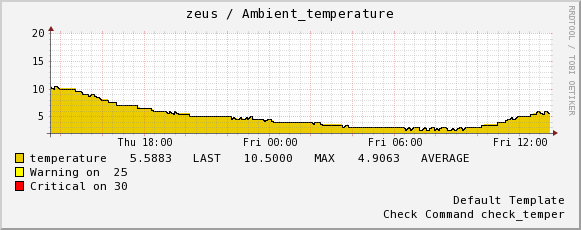
Well, now it’s too cold. The UK has had a bit of a cold snap lately. Outdoor temperatures in Bristol last night got as low as -3 °C, and in turn the temperature in my loft went down to 2.5 °C.

Thing is, that’s probably a bit too cold for my server now. The CPU is happily sitting there at 24 °C but the disks are all around 15 °C.
According to Wikipedia:
A common misconception is that a colder hard drive will last longer than a hotter hard drive. The Google study seems to imply the reverse – “lower temperatures are associated with higher failure rates”. Hard drives with S.M.A.R.T.-reported average temperatures below 27 °C had failure rates worse than hard drives with the highest reported average temperature of 50 °C, failure rates at least twice as high as the optimum S.M.A.R.T.-reported temperature range of 36 °C to 47 °C.
So my disks appear to be at risk of failing sooner. Worse yet, they’re not consistently at 15 °C but fluctuate wildly on a daily and seasonal basis. Looks like all I can do is keep my data on a redundant array and swap out any disks when (not if) they fail.
A friend of mine spotted that his bank claims to use “the highest security available” when actually they use ARC4 and 1024 bit RSA. He sent them this:
Dear HBOS security
I have recently received the below message in regard to your paper-free service. While the message was genuinely sent by yourselves, I do take issue (and most strongly so) with the statement that “You can access our paper-free service safe in the knowledge that it uses the highest level of security available.” In fact, your SSL security is bordering on outmoded; if you took security seriously then you would certainly use 128- or 256-bit AES (rather than ARC4) and 2048- or 4096-bit (rather than 1024-bit) RSA. I very much hope you already know that NIST will consider 1024-bit RSA (equivalent to an 80-bit symmetric key in terms of the effort required to break it) officially obsolete as of 2010, so I would certainly have expected that you would transition to 2048-bit or longer RSA keys by now, although I still hold out hope that you will finally do this before the new year is upon us. Until then, I would suggest that you do not allow misleading statements such as the below to be issued as regards your security provisions.
Yours faithfully
B S T
Having received no response after several weeks, he then sent them this:
Dear HBOS security
Since I sent the below message over a month ago, I have received no response but for an automated acknowledgement which has not been followed up. However, I have received another message seeking once again to inform me that you supposedly use the highest level of security available. With 2010 almost upon us, and with Christmas cheer in my heart, I decided to give you the benefit of the doubt and check to see if, in fact, you have at last dragged yourselves into the 21st Century as far as encryption algorithms are concerned. It was with disappointment, then, albeit little surprise, that I found no change since I had sent the previous e-mail. It is pertinent, although perhaps somewhat ironic, that even the Web-based interface through which I write this message is served along with DHE-RSA-AES256-SHA encryption.
Perhaps it was not clear enough to you lackwits the last time, but a viable security policy consists in practice of more than simply claiming that something is highly secure and hoping that nobody will notice otherwise. On the other hand, perhaps I should not have such high expectations of the competence of a bank that invested heavily in US mortgage-backed securities, which anyone with an ounce of common sense could see had been vastly overvalued due to a financial mania, and failed to make a sufficiently early exit from this market, with clearly disastrous consequences suffered as a result. If you insist on continuing to pursue these games of brinkmanship not only in your financial dealings (alas, supposedly your primary competency) but also in respect of basic consumer protection such as website security, then perhaps I shall be better off to take advantage of the recent market corrections to withdraw all but a nominal sum from my current account and make sounder investments by acquiring additional gold, silver, and foreign currency instead.
Yours, with much disdain
B S T
He has yet to receive a response, but we shall see what they say in the end.
Today I signed up for Twitter – not for personal reasons but because I needed it for work. Of course I’ve heard about it in the past as the leading micro-blogging service, but it hadn’t interested me in the slightest.
I have used Facebook since its early days (when you could only get in if you had an academic email address!), primarily to keep in touch with friends. When they brought out the status updates feature, I couldn’t see the point. Even less so having something like Twitter that’s purely status updates.
There are so many ways these days to get content out there and onto the web. But I can’t see the point in many of the newer sites.
Like I said, I use Facebook as a way to keep up with friends whom I don’t see very often. While I was at school, MSN Messenger was all the rage, but now we’re a bit more grown up we don’t all have time to sit on MSN all night. So Facebook is a convenient way to keep in touch from time to time – given that email is only really used for work these days.
But my only friends on Facebook are friends in real life. I don’t meet people through Facebook. For me, it’s just a direct replacement for emailing friends or chatting on MSN. I don’t broadcast my life to the world. I can’t see why they’d care.
Which brings me onto Twitter. I can’t imagine that anyone would be interested in snippets of my daily life. If they’re that interested, they can text me and ask. As I mentioned, I now have a Twitter feed and you can follow me if you want – but I don’t recommend it. I’m not intending to write anything interesting – only to use it for following boring feeds like these from the University of Bristol.
I’m more interested in personal websites, often in blog format. Maybe it’s because I used the web for years before these social, collaborative sites popped up, and the only resources available were traditional websites.
I’ve had my own website for over a decade now, in one form or another. When I was a kid, I didn’t have much of interest to say and there was nothing on the site. Nowadays I have two blogs: this one, mainly for technical articles, guides, reviews and so on; and my photo blog where I publish photos that I have taken.
I’m a geek, and so I have my own server and I run these blogs from scratch using WordPress. Obviously such an approach isn’t going to work for everyone, which is why I like sites like Flickr. It’s a really easy way to get your work online. I set up my own Flickr page some time ago, before I decided where I was primarily going to host my photos.
As you can see, there’s hardly anything on it and only two comments. I’ve worked a bit harder to promote my official photo blog, which also gives me the freedom to customise it exactly as I want, and here I have had thousands of views of my photos.
I’m not saying that “Web 2.0” is a bad thing – I’m just saying it only works for me in limited ways.
I want to publish my articles and photos in a more traditional format, and I only use Facebook because most of my mates don’t use MSN any more.
This is another portrait of Hana, along the same lines as many I’ve done before.
But this time, inspired by Stu’s recent challenge entry, I had a go at lighting the background with a coloured flash.

It’s OK, but the LCD on my camera isn’t very good and since looking at the photo on my PC, there are many things I’d change.
I was aiming for a half-lit face but I hadn’t expected the entire face and shoulders to come out so dimly. Unfortunately that’s as many photos as I’m allowed to take today.
Unless I come up with something better by Tuesday, this will be my entry into this week’s photo challenge – “pictures of people”.




 Jonathan Gazeley