Canon Sure Shot A-1

Released 1994

OK, don’t laugh. I bought this camera specifically for an activity holiday, since it’s waterproof and very robust. It’s not very interesting, but it’s useful. It’s also not a bad point & shoot, and of course it lends itself to unusual shots.

See all photos taken with the Sure Shot A-1.

Canon A-1 Sure Shot
Canon A-1 Sure Shot

At a glance

Lens Fixed 32mm f/3.5
Film 135
Focus Auto
Meter Auto

Voigtländer Bessa 6×9

Released 1929

I’ve wanted a bellows camera of some sort for ages, mainly for their antique looks. Trouble is, it’s hard to find specimens with the leather intact and still light-tight. This one is in poor cosmetic condition, but still mostly works.

The shutter is a bit sticky at slow speeds and when I first got it the winding mechanism was rusted and even the film had rusted onto the frame. There was a film in the camera with some photos of a previous owner, which I developed.

See all photos taken with the Bessa.

Voigtlander Bessa 6x9
Voigtlander Bessa 6×9

At a glance

Lens Fixed 110mm f/4.5
Film 120 (6×9)
Focus Guess
Meter None

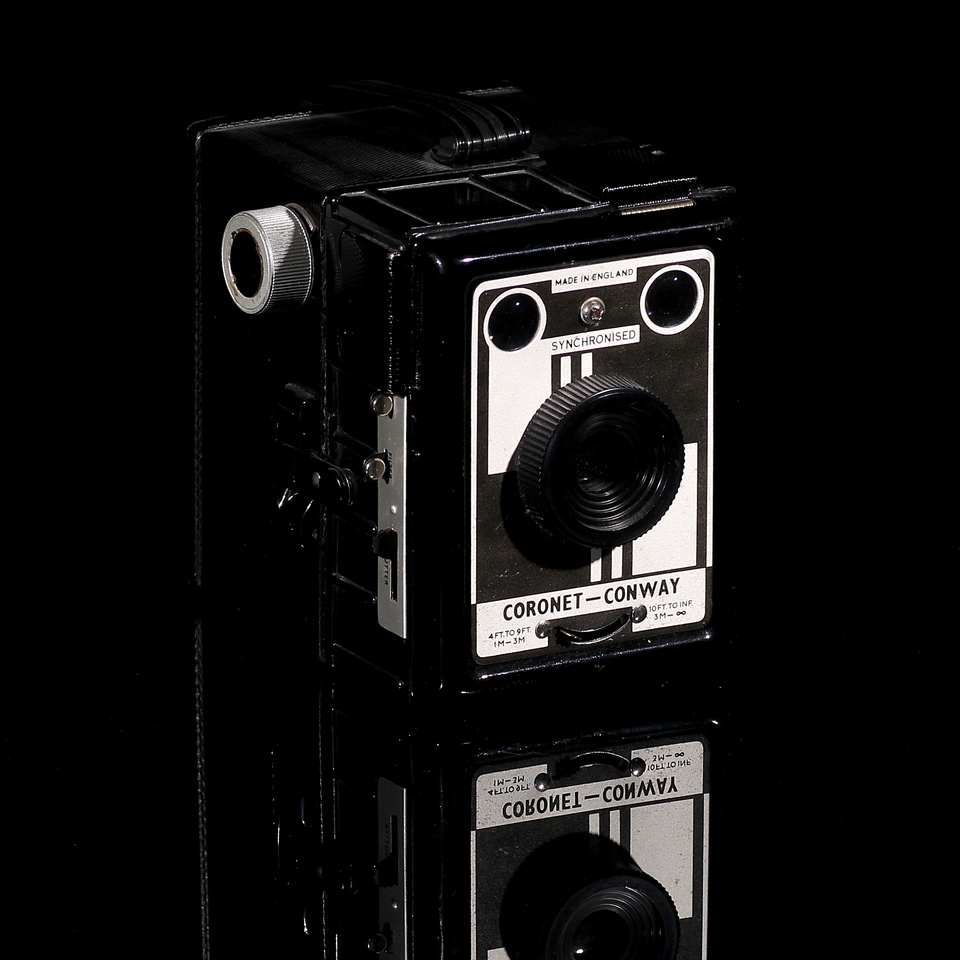
Coronet Conway – Synchronised Model

Released 1955

I bought this camera from eBay as a way of getting into medium format photography. I also managed to get hold of the proprietary flashgun, the Coro-Flash, which takes flash bulbs.

See all photos taken with the Conway.

Conway Synchronised
Conway Synchronised

At a glance

Lens Fixed 110mm f/18
Film 120 (6×9)
Focus Fixed, with close-up lens
Meter None

Canon AE-1 Program

Released 1981

In September 2009, I was given this Canon AE-1 Program 35mm SLR with a 50mm prime lens. It’s actually the first film camera I have ever used, aside from disposable cameras in my childhood. I absolutely love the camera – it’s what started my interest in film photography. Now, I have a collection of lenses for the AE-1 and it is my “main” camera, except for when I’m in a hurry and need to shoot digital.

See all photos taken with the AE-1P

Canon AE-1 Program
Canon AE-1 Program

At a glance

Lens Canon FD mount
Film 135
Focus SLR split screen & microprism
Meter CdS with program

Canon EOS 450D

Released 2008

In March 2010, I decided to make the leap to a digital SLR, having outgrown my Fuji S9600 bridge camera. I have a decent selection of lenses now, so the 450D is extremely versatile.

See all photos taken with the 450D, or search by lens.

At a glance

Lens Canon EF & EF-S mount
Film Digital!
Focus SLR auto
Meter Digital

How many megapixels do you get from film?

Well that’s a question. There’s no easy answer, but I’ll discuss it a little here. If you just want the figures, scroll down to the table!

The number of film “pixels” (grains) does not equal to the resolution of the film – unlike pixels on a digital sensor. For now let’s ignore this fact and get down to some numbers.

I’ve checked in various places, and the consensus seems to be that a frame of 35mm film (24mm × 36mm in size) has up to 20 megapixels, assuming the film is fine-grained, and was exposed and developed properly. We arrive at this number by scanning a negative at progressively higher resolution (in terms of dots per inch, dpi), seeing smaller and smaller artefacts in the picture, until we reach a stage where increasing the dpi of the scan does not yield more smaller grains in the scan. At this stage, we see what digital resolution we have scanned the image at.

There’s massive scope for mishandling film and reducing the fineness of the grains, which means we will effectively lower the digital resolution of the negative. It’s extremely hard to judge this here, so we will assume that our hypothetical photographer was careful in handling his film. We will also ignore any loss of sharpness caused by imperfections in the lens.

Taking the optimum value of 20 megapixels for a 35mm frame, and extrapolating this to other film formats…

Format Size (mm) Megapixels
35mm (135) 24 × 36 20
120 6×4.5 medium format 60 × 45 63
120 6×9 medium format 60 × 90 125
5×4″ large format 127 × 102 300
10×8″ large format 254 × 203 1,200

As I touched on earlier, raw “pixel” (grain) count doesn’t necessarily give better resolution with film. Grains on film are different sizes and not in a neat grid, like pixels in a digital camera’s sensor. True resolution, as seen with the eye, has more to do with resolving closely-spaced pairs of fine lines.

Given that you usually need more film grains than digital pixels to achieve the same optical resolution as seen by the eye, it’s a reasonable assumption that my 35mm SLR (~20 megapixels) is similarly performing to my Canon 450D DSLR (12 megapixels).

Some high-end digital cameras such as the Hasselblad H4D-60 can now achieve 60 megapixels but this still doesn’t come close to professional medium format cameras using 120 film (still used for lots of magazine and glamour photos), or large-format cameras (still almost exclusively used for landscape photography).

So there you have it. Film can produce a considerably higher optical resolution than digital cameras, when used carefully.

Jaywalking

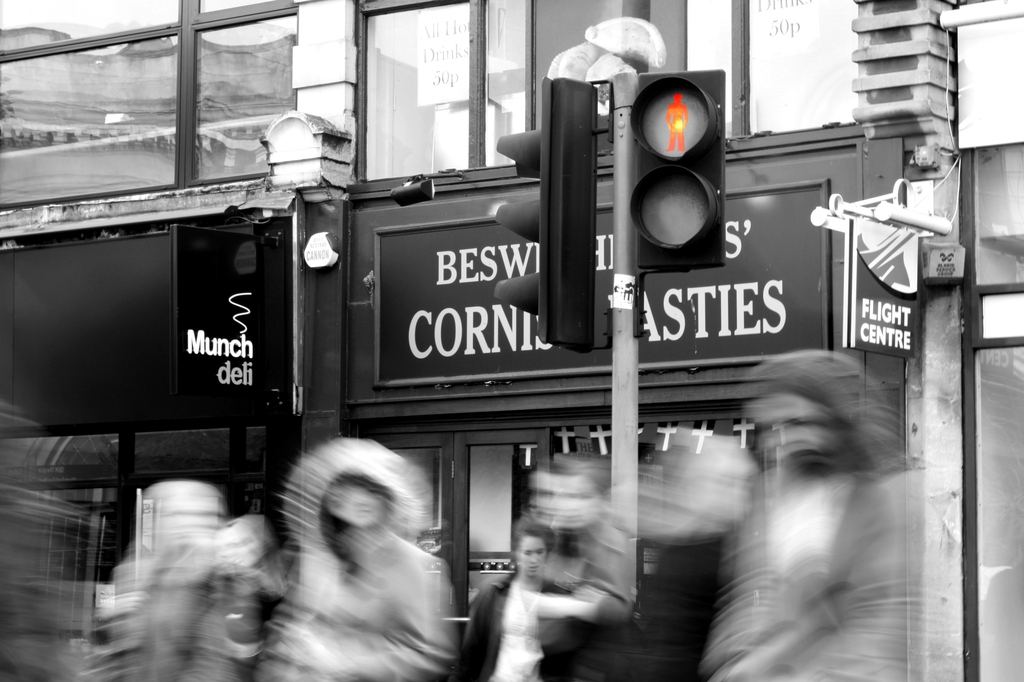
Jaywalking, or as it is more concisely known in the UK, crossing at the red man, really winds me up. So I decided to capture it for this week’s Photo Challengethings that make you angry.

Working on a university campus, it wasn’t hard to find dozens of students walking in front of cars and cyclists on their way to lectures.

The thing I found most surprising is that with a casual glance, you’d expect a red man to be red, and his background to be black. Once I got home and looked at my photos, I noticed how yellow the red man is and how pale the background is. Maybe that’s why nobody pays any attention to him! Either way, I had to make him a lot redder so the black & white version didn’t look daft.

Evening in Oldbury Court

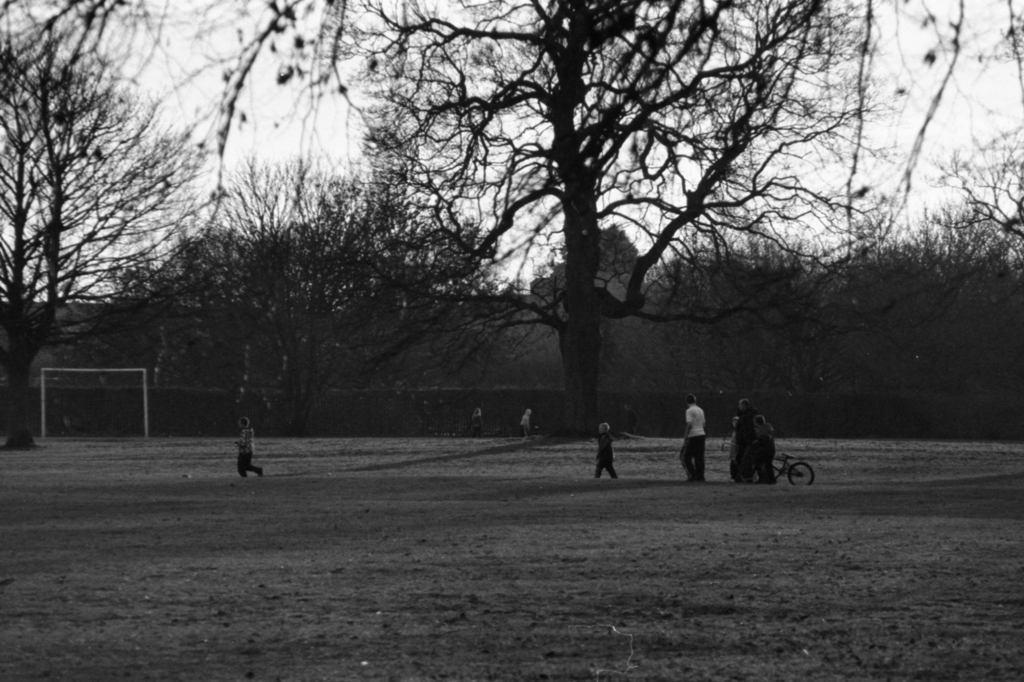
The other evening I went to Oldbury Court to catch some of the golden sunrays. I used an old lens with a primitive lens coating, so there was plenty of lens flare from the low sun. In the viewfinder it was all sorts of magical colours, but you only get to see the black & white version.

The contrast is low, but it gives you the impression that you’re looking into the setting sun and seeing things in silhouette.

More of Lou Lou

I rarely shoot film indoors, but since I had a roll of fast film in the camera this week I was able to shoot a few pictures of Lou Lou with daylight from the window and some artificial light. These are my favourites.

If you’ve seen Lou Lou before, you’ll know she’s mainly creamy white with black and ginger markings. Of course, the ginger markings show up as grey in these photos 🙂