
It’s about time I had a new profile picture. I took these recently for a client. In the first picture I’m relaxing with a coffee, and in the second I’m pretending to have toothache. It’s probably best not to ask!


It’s about time I had a new profile picture. I took these recently for a client. In the first picture I’m relaxing with a coffee, and in the second I’m pretending to have toothache. It’s probably best not to ask!
Part of a series of specially-commissioned photographs I have been taking for use in a textbook.

Part of a series of specially-commissioned photographs I have been taking for use in a textbook.

I took this photo of Hannah and me holding hands at the top of Troopers Hill, overlooking Bristol, just as the sun went down. It’s my entry into the Valentine’s Day Photo Challenge.

Part of a series of specially-commissioned photographs I have been taking for use in a textbook.

I enjoy tinkering with professional audio kit – usually for recording more than live work or performance. Largely speaking, I’m an amateur – I don’t normally make any money from audio services (although I do occasionally do work on a paid basis). Having a limited budget to fund my hobby, I can’t always buy the best of everything. Often, this means I buy Behringer equipment, as it is inexpensive and mass-produced.
 Clearly it isn’t quite as good as equipment that’s several times the price, but that’s to be expected. In my opinion, Behringer kit is pretty good quality, so long as you’re not going to rely on it daily for heavy-duty professional purposes. Everything is a compromise, but the Behringer microphones I’ve used are made of strong metal and feel nice, and sound great.
And yet, everywhere I look in online audio forums, people say how awful Behringer is, how nobody should ever, ever buy their kit – even home amateurs with hardly any budget.
While it’s true that Behringer kit isn’t the best the world has ever seen, it is the best at its price point and it represents remarkable value for money. All of the Behringer kit I’ve ever owned has been outstanding – good sound quality, good build quality, reliable and with a professional feel. For someone who has only used dynamic microphones before, using even a cheap condenser microphone is a miracle in its own right. To date, I’ve owned the following Behringer kit:
Based on the positive experience I’ve had with every single one of these products, I wouldn’t hesitate to buy more products from their line-up. In fact, on my wish list I have more C-2, B-1 and B-5 microphones, and if I have need of it, a more powerful amplifier and speakers for PA use.
So, for anyone reading this: Behringer equipment is fine. It’s better than fine. It’s good, and is excellent considering the price. I recommend Behringer wholeheartedly to anyone setting up a home studio or for occasional use, for example in a church.
Anyone who tells you Behringer is no good for amateur small-scale professional is just a snob 😀
The one thing I will concede about Behringer is that their website is full of overused hyperbole such as ultra and super. Never mind – the kit is good!
Last weekend we visited our friends Fraser (my best man to-be) and his partner Suzie at their new flat. Fraser specifically asked me to bring some camera and lighting equipment so I could take his picture with Suzie, as they don’t have many “couples” pictures.
Needless to say, I obliged. I don’t often do portraits, but I do own a Mamiya RB67 which is a 1970s medium format camera. Its native environment is portraiture and fashion photography, so it was nice to use it for its intended purpose. While the camera, backdrop and lights were set up, Fraser also took some pictures of me and Hannah. It’s not often I have my picture taken, as I’m usually on the other side of the camera.
I’m not too experienced with lighting portraits, but on balance I’m quite pleased with how these have come out.


All pictures shot with Mamiya RB67 on Ilford FP4+ film, developed in Ilford Microphen developer. Group shots taken with Mamiya-Sekor C 127mm f/3.8 lens; individual headshots taken with Mamiya-Sekor C 180mm f/4.5 lens. Flashgun with white shoot-through umbrella camera left, speedlight bounced off a white wall camera right, flashgun behind subjects to illuminate backdrop.
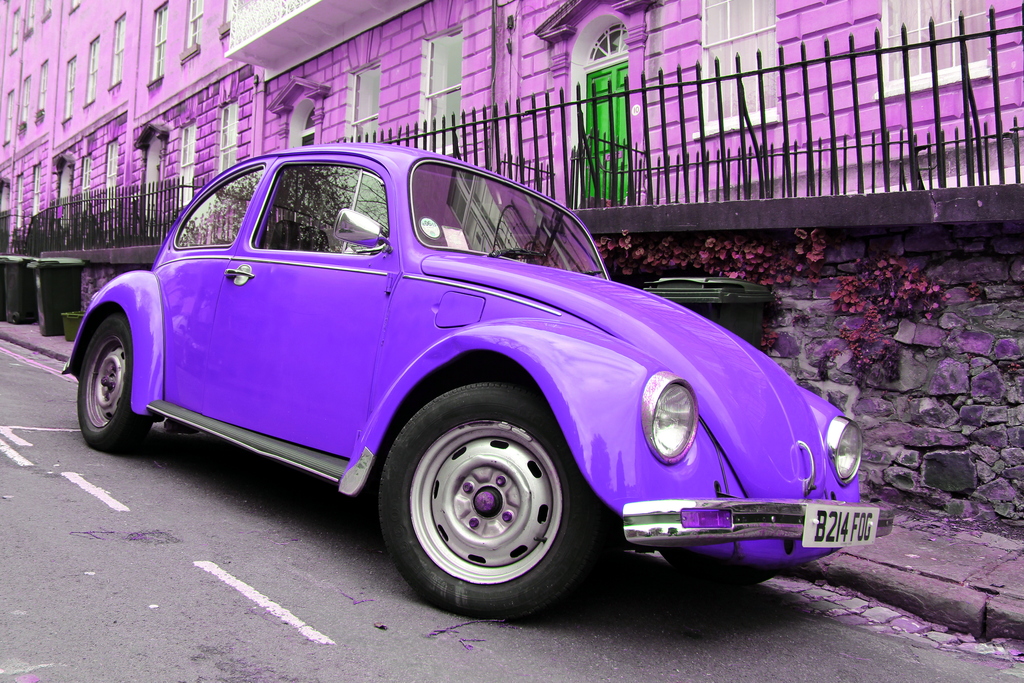
I don’t normally go in for this pop art style of photography, but when I saw this Beetle parked up, I couldn’t resist.

For several years I’ve been making recordings of church choirs, usually accompanied by an organ. I’ve been using a pair of Behringer C-2 small diaphragm cardioid condenser microphones, and until now I’ve been reasonably pleased with my technique – and then I tried the ORTF technique.
In the past, I’ve always used the X-Y technique, where two cardioid microphones are arranged so their tips are in the same position, and angled 90° apart.
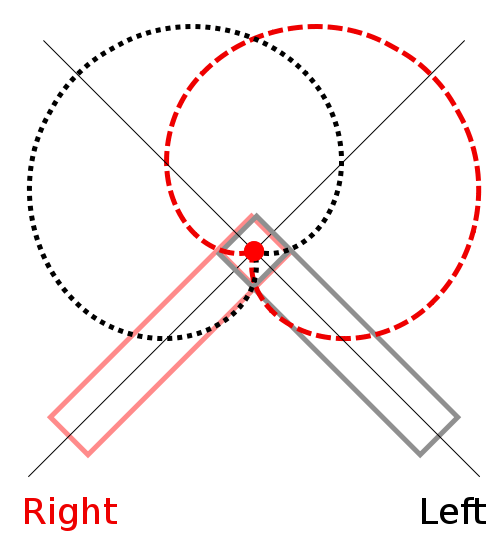
I’ve been using a pair of small diaphragm cardioid condenser microphones to capture the choir in stereo. My small diaphragm microphones have fairly poor low frequency response so I’ve been adding a single large diaphragm condenser microphone to pick up the low frequencies, and adding it to the mix with a low-pass filter of about 100 Hz – effectively playing the role of a subwoofer. I record multitrack, so it’s possible to decide on the levels later on, and omit the extra mic if necessary.
So this week, for no particular reason I remembered the ORTF stereo technique and decided to try that at Candlemas choral evensong. I really hoped it would work out because the choir were singing one of my favourite pieces – When to the temple Mary went by Johannes Eccard.
In the ORTF technique, two cardioid microphones are angled 110° apart, with their tips 17cm away from each other. This mimics human ears.

On paper, ORTF gives a more realistic stereo image, at the expense of being not quite phase-safe if flattened to mono. That’s a gamble I’m prepared to take – I can’t think of any real reason why this choral recording would be played back in mono. I also added my large diaphragm to pick up the rumble of the organ.
Theory is all well and good, but how did the ORTF technique stand up in the real world? Well, I thought it sounded great. The choir was bright and clear and yet smooth and rich – the dainty sounds of the vowels showed through clearly without being overly sibilant. Stereo placement is excellent and the image is a pleasure to listen to.
As expected, there was a lot less room ambience and reverb picked up – presumably because the microphones are facing more towards the side walls. I think I could fix this by moving the pair of microphones around the building. However, it had a nice side effect that it also picked up less of the congregation’s fidgeting, which is always a bonus when recording a church service.
Surprisingly, the low frequency pickup of the small diaphragm condensers seems vastly improved in the ORTF arrangement, so I didn’t even bother listening to the track recorded on the large diaphragm.
So I think that settles it. For this kind of work in the future I will be using the ORTF stereo microphone technique, provided I can experiment with the microphone positioning to capture the best room ambience 🙂
This weekend I visited London with friends from choir. It wasn’t your average tourist outing though – we had tickets to go to the top of the Shard. This new building is the tallest in the EU and has the highest viewing platform in the UK. We went up at about 3:30 and stayed until sunset. The weather has been bleak recently but we were treated to a magnificent golden hour, followed by an intense orange sunset which turned pink just before the sun went down. What a fantastic day!
I shot hundreds and hundreds of photos, but I’ve whittled it down to a select few for your viewing pleasure. I’m also trying out a new mosaic-style photo gallery for the first time. These photos absolutely must be seen in large mode – click and use the arrows to move through.






 Jonathan Gazeley