
There’s been a lot of black & white photos on my blog lately, so I think it is about time for a splash of colour. Here are some water droplets perched on my grass.

There’s been a lot of black & white photos on my blog lately, so I think it is about time for a splash of colour. Here are some water droplets perched on my grass.
One of my favourite features about my house is the staircase. It’s tall, light and airy and has one of those halfway landings where the stairs do a U-turn. We’ve lived here for more than three years now and I’ve finally got round to implementing an idea I’ve had for ages – a stairway photo gallery.
I decided the theme should be churches (one of my favourite areas of photography) and so I created all the prints from negatives in the darkroom. The pictures all depict interior and exterior scenes from parish churches and cathedrals in England. I’m pleased with the result.

I’ve been using small-diaphragm condensers for a while now and decided it was time to step up to something a bit less entry-level. Don’t get me wrong, my Behringer B-5s are great but they have their limitations. I hope these notes will be useful to someone else who is looking to step up from entry-level condensers such as the Behringer C-2, C-4 or B-5. (If you’re not sure of the difference between these Behringer mics, see my article to explain the range).
I regularly use the omnidirectional capsule on the B-5s and this is something I need from a replacement set of microphones, and this narrows the choice a bit. In the end I chose a pair of Sontronics STC-1. This is a relatively little-known microphone. It’s a British brand but I don’t think it is readily available in the USA, so it tends to get relatively few mentions online. It’s the reverse of the Studio Projects microphones which are popular in the USA but hard to find in the UK. This article is partially a review of the STC-1 and partially a comparison with B-5 and a brief explanation of why you might want to upgrade.
On paper, the B-5 and STC-1 are remarkably similar in spec. You never can be quite sure how honest Behringer and other budget manufacturers are with their specs, while I expect more accurate specs from Sontronics. Figures marked with an asterisk* were not published by the manufacturer, but measured by me. Hopefully the STC-1 will give better clarity on choral recordings, which is something that can’t readily be quantified.
| Behringer B-5 | Sontronics STC-1 | |
|---|---|---|
| 20Hz – 20kHz | Frequency response | 25Hz – 20kHz |
| -38 | Sensitivity (dBV) | -38 |
| 12.6 | Sensitivity (mV/Pa) | 12.0 |
| 70Ω | Impedance | 200Ω |
| 140 dB | Max SPL | 137 dB |
| 90g | Weight | 230g |
| 18mm | Diaphragm | 20mm* |
| 16 dB | Self noise | 16 dB |
| 20mm | Width | 24mm* |
| 120mm | Length | 172mm* |
On receiving the STC-1s, the quality is immediately noticeably higher. As the STC-1 manufacturer specs did not include size or weight, I was expecting something similar to the B-5. However the STC-1 is noticeably larger and heavier. It feels expensive in your hand. The wooden presentation box with laser etching is a nice touch, but I actually prefer the cheap plastic carry case supplied with the B-5 since it has a carry handle. The padded box has spaces for a hard mic clip and a foam wind shield. There is no extra space for separately-sold interchangeable capsules, but if you leave the mic clip permanently on the mic stand, there is easily room for two capsules.


One of the B-5’s weak points is the delicate thread for screwing the capsules on. It is very thin and soft, and if you cross the threads once you’ve probably ruined the microphone. I’ve read reports of people having to use sticky tape to keep the capsule on. The STC-1 has a coarser and stronger thread that seems less prone to damage – however I think it would still be easy to damage it if you were not careful. Moral of the story: be careful.
The B-5 comes with one cardioid and one omnidrectional capsule included. The STC-1 comes only with a cardioid capsule included, while omnidirectional and hypercardioid capsules are sold separately. Unfortunately the capsules are sold in flimsy cardboard boxes. You’ll want to store the capsules in a more rugged box.
I tried to do a basic and unscientific noise test by cranking up my preamp to full with each mic connected in turn to see what noise was recorded. However I wasn’t able to get my house quiet enough. I placed each mic inside its padded box to keep outside noise to a minimum but the mics were still able to pick up the whirring of my laptop and even the cat walking around in the next room (I wasn’t able to hear that with my own ears). Finally the police helicopter started hovering somewhere nearby so that was the end of that. Noise test: inconclusive.
On paper, the B-5 and STC-1 claim to have almost identical sensitivity. I don’t have a quantitative way of measuring the sensitivity but I can say for sure that the STC-1 is more sensitive. With the B-5, I always set the gain on my preamp to the same place and got the right levels in the raw recording data. I set the gain to the same amount for the STC-1 and got approximately 3dB more signal in the recording. I had to back the gain down a little bit to avoid peaking. I can only assume this discrepancy is due to some possibly optimistic specs from Behringer.
More sensitivity is always good when you’re doing choral work (the quiet passages can be very quiet). I think you would want to enable the -10dB pad for louder applications.
There’s no other way of testing the real-world quality of a mic than using it for a real recording. I used my standard technique of spaced omnidirectional microphones to record evensong at St Mary’s, which I’ve used many times before. The STC-1s are spaced 40cm on a bracket which I only bought recently. The B-5s would have been a little bit further apart on two separate mic stands, thus giving a narrower stereo image.
As usual, I used the wind shields to prevent noise from convection currents in the air (that’s a real thing in large buildings like churches) and shock mounts to prevent unwanted foot noise on the suspended wooden floor. As you can see, the organ is at the back of the church and the choir are at the front, hence the omni capsules are needed.

This comparison is a recording of the Choir of St Mary’s, Fishponds singing Robert Stone‘s setting of the Lord’s Prayer in 2014 and again in 2015.
Behringer B-5
Sontronics STC-1
The STC-1 seems to have better clarity on consonants. Listen to the first line of the prayer, especially the word art. The STC-1 picked up a lot more bass from the organ. So much so, in fact, that I had to EQ it out about -6dB below 100Hz or it sounded like a subwoofer gone mad. Next time, I will use the low-frequency roll off.
Sorry to anyone who is hoping for a review of these microphones on acoustic instruments or drum overheads. Some time soon I’m hoping to work with a guitarist or mandolinist so I will be sure to post samples then.
First impressions are very good. With microphones it can be hard to compare them and see clear differences. Often you pay 5x more and get a microphone that is 10% better. It’s up to you whether that price compromise is worth it. However the STC-1 is noticeably better than the B-5 in pretty much every way. I can’t really quantify, but it sounds crisper on the consonants and yet smoother too. It’s hard to get the balance right with choral music. It’s early days yet, but I am pleased with my purchase and no doubt with some practice I will start getting even better results with my pair of STC-1s.
I have no hesitation in recommending the Sontronics STC-1 to someone who is looking to upgrade their small diaphragm condenser microphone without breaking the bank. This is an excellent step up from any of the Behringer small diaphragm condensers.
Not a very glamorous name, but there is a rail depot there and a good vantage point from St Philip’s Causeway. As it was sunny, I took this picture with my infrared DSLR.

Behringer make a range of budget microphones which are popular with home musicians and offer good value for money. Unfortunately their naming scheme is not that clear and it can be hard to know what you’re buying, and how the products relate to each other. This article is not supposed to compare Behringer microphones with other manufacturers, but just to help you understand the Behringer range when choosing a microphone.
Behringer doesn’t publish full information on all its microphones, so I’ve had to do a little digging. Firstly the products are split into several ranges:
The XM series dynamic microphones are good for live vocal use and can also lend themselves to drums. The T series is aimed at people who are already familiar with condenser microphones and who want a valve (vacuum tube) sound.
This just leaves the B and C series which seem similar in appearance and on paper. So what’s the difference between them? Is one more expensive or better than the other? Well, in general the B series is superior since they have true condenser capsules rather than the electret capsules of the C series, but It’s not quite that simple as there’s no direct mapping between the products in the B series and C series.
Behringer don’t themselves say that the C series have electret capsules, so I had to rely on third-party sources such as recordinghacks.com.
| B | C | |
|---|---|---|
| 1 | Large diaphragm cardioid condenser microphone. Better quality version of the C-1. | Small diaphragm cardioid electret microphone. Cheaper version of the B-1. Also comes in a USB edition. |
| 2 | Large diaphragm switched multi-pattern condenser microphone. A more feature-filled version of the B-1 and a better quality version of the C-3. | Small diaphragm cardioid electret microphone. Similar to the C-4 but older and somewhat better quality. Sold in a twin pack. |
| 3 | – | Small diaphragm switched multi-pattern electret microphone. A more feature-filled version of the C-1 and a cheaper version of the B-2. |
| 4 | – | Small diaphragm cardioid electret microphone. Similar to the C-2 but apparently with cheaper internal components. Sold in a twin pack. |
| 5 | Small diaphragm multi-pattern condenser microphone with cardioid or omni heads. A more feature-filled and better quality version of the C-2. | – |
If you’re a beginner, chances are you might not recognise all of the terms I’ve used in this table, so here’s a glossary.
In my opinion, it is best to avoid the electret C-series unless you are on a very tight budget. They sound tinnier and have worse noise characteristics. However the C-2 is actually a decent microphone when used carefully and for the price, it is hard to beat. The C-1 and C-3 attract poor reviews and the C-4 holds no compelling advantage over the C-2. Based on my personal experience I am happy to recommend any of the B series.
If you want some recommendations of a particular type of microphone for a particular job, then look no further!
| Application | Recommended mic | Acceptable mic |
|---|---|---|
| Solo vocal | B-1 or B-2 | C-1 or C-3 |
| Acoustic guitar etc | B-5 | C-2 or C-4 |
| Drum overheads | B-5 | C-2 or C-4 |
| Acoustic guitar etc | B-5 | C-2 or C-4 |
| Acoustic guitar etc | B-5 | C-2 or C-4 |
| Stereo XY | Pair of B-5 with cardioid head | Pair of C-2 |
| Stereo AB | Pair of B-5 with omni head | – |
| Stereo MS | B-2 in Fig-8 and B-5 with cardioid head | C-3 in Fig-8 and C-2 |
Finally, let’s have a look at the complete specifications of all the microphones in the B and C series. Some of these criteria are self-explanatory but others are more obscure. In some cases, I’ve put an arrow ↑↓ next to the category to mean “higher is better” or “lower is better”. Be careful to check for the minus signs! The blank fields are where Behringer declined to provide the information. The C-1 and C-3 have a reputation for being noisy microphones and their self noise specs are notably absent…
| Model | B-1 | B-2 | B-5 | C-1 | C-2 | C-3 | C-4 |
|---|---|---|---|---|---|---|---|
| Image |  |
 |
 |
 |
 |
 |
 |
| Frequency Hz |
20Hz-20kHz | 20Hz-20kHz | 40Hz-20kHz | 20Hz-20kHz | 40Hz-18kHz | 20Hz-20kHz | |
| Sensitivity dBV ↑ |
-34 | -36 | -38 | -33 | -41 | -40 | -38 |
| Pattern | Cardioid | Cardioid Omni Figure-8 |
Cardioid Omni |
Cardioid | Cardioid | Cardioid Omni Figure-8 |
Cardioid |
| Type | Condenser | Condenser | Condenser | Electret | Electret | Electret | Electret |
| Impedance Ω |
50 | 100 | 70 | 100 | 75 | 350 | 75 |
| Max SPL dB ↑ |
138 | 138 | 140 | 136 | 140 | 142 | 136 |
| Self noise dB(A) ↓ |
13 | 17 | 16 | 19 | 23 | ||
| Weight g |
461 | 550 | 90 | 420 | 90 | 420 | 60 |
| Diaphragm mm |
25 | 25 | 18 | 16 | 16 | 16 | 16 |
| Signal to noise ratio dB ↑ |
81 | 77 | 78 | 75 | |||
| Width mm |
58 | 56 | 20 | 54 | 20 | 54 | 23 |
| Length mm |
174 | 210 | 120 | 180 | 94 | 180 | 94 |
Of course, numbers only tell you so much and ultimately it comes down to what sounds best for your purposes to your ears. I often test out new microphones and techniques and you might these articles useful or interesting:
For Christmas, I was given a kumquat tree. Miraculously, it has survived thus far and so I photographed it for this week’s fruit-themed Photo Challenge. I had intended to make a more elaborate still life composition, but when I looked at it, I thought the contrast of the gnarly tree trunk and the smooth fruit was sufficient.
Digital image taken with Canon EOS 600D and Canon EF 50mm f/1.8. Mixed artificial light sources (some LED, some CFL), red channel extracted from the colour image to make a monochrome and selenium tone added.
A quick shot of a chess board for this week’s photo challenge, for reasons that will become clear!
Digital shot with Canon EOS 600D and Tamron 90mm f/2.8 macro. Blue tint and fake film grain added digitally.
Yesterday I went for a stroll around Prior Park and the Bath Skyline walk. Well, it wasn’t so much a stroll as a hike, since I was carrying about 12kg of camera equipment on my back. It seemed to pay off though, since I returned home with ten pictures, and this is my favourite. This is the Palladian Bridge in Prior Park, with the city of Bath in the background.

Taken with my Mamiya RB67 with Sekor 250mm f/4.5 on Ilford FP4+ film at 1/250, f/11. Scanned directly from the negative, tone added digitally.
There’s a bewildering choice of microphone types available and it can be hard to know which type of microphone to choose, let alone which make and model within that type.
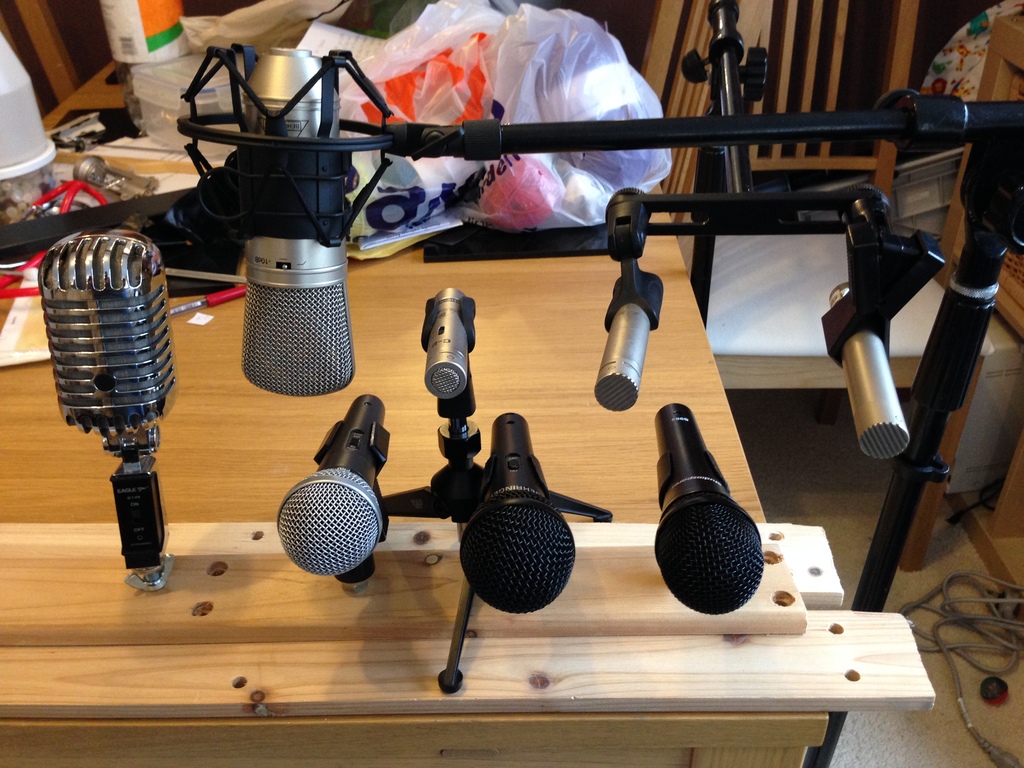
I grabbed one of each of my microphones and performed a simultaneous microphone test on various test sounds. Maybe this unscientific video test will even be useful to someone!
| Microphone | Type | Pickup pattern |
|---|---|---|
| Behringer B-1 | Large diaphragm condenser | Cardioid |
| Behringer C-2 | Small diaphragm condenser | Cardioid |
| Behringer B-5 (cardioid capsule) | Small diaphragm condenser | Cardioid |
| Behringer B-5 (omni capsule) | Small diaphragm condenser | Omnidirectional |
| Behringer XM1800S | Dynamic | Cardioid |
| Eagle G148 | Dynamic | Cardioid |
| ProSound YU37 | Dynamic | Cardioid |
| StudioSpares S955 | Condenser | Cardioid |
I tried to think of a variety of different sounds to test the frequency response of each microphone.
The main problem with my experiment is that each microphone receives sound from the source at a different angle. Each sound source broadcasts different sounds in each direction, so it isn’t a fully fair test, but I’ve tried to get the microphones as close together as possible. The alternative was to make each sound multiple times, once in front of each microphone. This isn’t a fair test either, as it’s impossible to make exactly the same sound twice.
It was a fun experiment but I don’t think the results are very useful. In this test, all of the microphones sound very similar. This is definitely not true and the difference would be clear if I was recording a choir in a church or even an acoustic guitar or something like that. All of my test sounds were quite quiet since I don’t have the ability to do proper musical testing at home, but at least it was an interesting concept.
Mist + Bristol = Mistol. Well, I thought it was funny anyway.
These two shots were taken on a roll of film that’s been in my Zeiss Super Ikonta A 531 for a few weeks. Many of the pictures didn’t come out, because I forgot that the 1937 Tessar lens is not coated, and flares very easily when shooting into the sun.
The first picture was taken on Troopers Hill, minutes after the solar eclipse had passed. It was a hazy morning and the juxtaposition of these people talking with the church of St Aidan in the background was too good to miss.


The second picture is a view from Bristol’s centre towards the floating harbour. It was a slightly misty day anyway but I saw thick mist swirling around over the water. I wondered why the mist had gathered in such a concentrated area, and then I thought a boat was on fire. I later found out that it was a public art installation to highlight climate change.
Both pictures were taken on Ilford FP4+, scanned and had the tones added digitally. Physical prints from these negatives with chemical toners do exist too 🙂




 Jonathan Gazeley