I don’t often get to shoot people* so I jumped at the chance to take pictures of my friends Nathan and Coralie. It was a fun shoot, and I think this shows in the pictures.
And so we kick off the first picture of Infrared Week with this photo of the building perched on the edge of the Avon Gorge.
In infrared, grass appears white and blue skies appear dark. Buildings are mostly unaffected and the picture has an odd effect where it looks like some things are in negative.
Spring has sprung, and there is more infrared radiation in the sunlight. You can tell because it’s warm!
Mamiya C220
I’ve been saving some infrared film in the freezer since last summer, and I’ve finally had a chance to shoot it in my dedicated infrared camera – a Mamiya C220TLR. In the past I’ve shot infrared film in an SLR but as the filter is opaque to the human eye, you can’t see anything in the viewfinder. It’s a pain to repeatedly remove and replace the filter, so I decided to buy this twin-lens reflex camera which has separate lenses to look through, and to take pictures through. I can keep the filter on the so-called “taking lens” all the time without obstructing the viewfinder.
So to cut a long story short, over the last week or so I’ve been shooting pictures in infrared. I’ve now finished shooting the film, processed it in the darkroom, and I have decided to publish one picture each day for a week*
* It’s a slight cheat. There were only 6 pictures I liked enough to publish, so today’s kick-off ramble counts as the seventh post 😛
Not too long ago (on the same day I visited West Quantoxhead), my travels took me to the village of Uphill, not far from Weston-Super-Mare. There is a semi-ruined church which sits on the edge of a cliff, overlooking the sea. It was a pretty building so I took a picture. I like it; this one is going in my album of favourites.
Last night it was clear and there was no moon. I headed out with my telescope to see what I could see, and ended up photographing Messier 5, which is a globular cluster.
This composite is made from about 100 images, each 3 seconds exposure with my Celestron NexStar 127 SLT and Canon EOS 600D, processed with Registax.
Messier 5
I’m a novice at deep-sky astrophotography and I’m reasonably pleased with my first attempt at photographing a cluster like this. The only deep-sky object I’ve photographed before is the Orion Nebula (M42).
I know a poor workman always blames his tools, but I wish I had chosen a Newtonian telescope rather than a Maksutov, simply for its light-collecting ability. I would also like to be able to expose for longer than 3 seconds, but unfortunately my inexpensive Celestron NexStar doesn’t slew smoothly, meaning anything longer than 3 seconds gets blurred. With a steadier mount, I could expose for longer and resolve more of the dimmer stars in Messier 5.
Netham (in Bristol) and Glastonbury don’t really have anything in common, except that they shared a film in my Canon T90.
At Netham there is a lock and a weir, and further upstream, there is Brunel’s Avon Bridge. The bridge is a Grade I listed building but unfortunately it has a steel-frame bridge built alongside it on both sides so it is no longer possible to get a good view of it. Fraser and I went clambering and managed to get underneath the bridges. It was quite dark underneath and we were far too close to get a decent picture of the main span, so I had to settle for a picture of one of the side arches. I’m sure there’s a proper word for a “side arch” but I’m no architect 😉
Geese on Netham weirNetham weirAvon Bridge
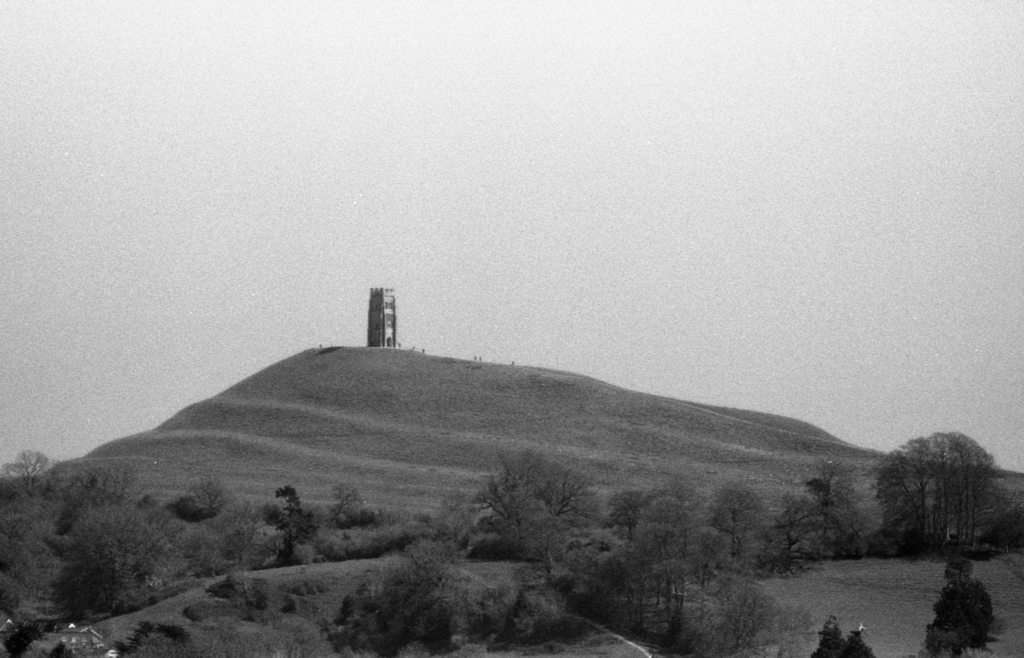
As promised, onto Glastonbury. I didn’t actually venture into the ancient town, but instead explored the area around Glastonbury canal, a couple of miles from the city and mostly now used for quarrying(?) peat. It offers a great view over the city but also has several lakes which attract wildlife, so it is a popular destination for wildlife photographers.
Earlier this week in a charity shop in central Bristol, I discovered a parish magazine from my church, St Mary’s, Fishponds, dating from October 1947. I decided to scan it in and reproduce it here for anyone who is interested – look at the images below or download the PDF version. I think it’s fascinating – partly reading the articles of the 1940s but also looking at the adverts for long-forgotten shops that used to exist on Fishponds Road.
On top of that, this week’s Photo Challenge is called “retro“, and we have to take a picture that looks like it was taken a long time ago. It’s quite easy to fake an old-style photo but quite hard to find a scene that doesn’t include modern cars or buildings. I pondered the idea for a while before realising that one of the few things that haven’t changed much in a century is church buildings. So this evening after work, I took my 1887 Lancaster Instantograph out to St Mary’s and took this picture.
St Mary’s, Fishponds
There’s no Photoshop or Instagram here – this is a genuine picture taken in 2013 on a 126-year-old camera, using traditional photographic methods. I accidentally overdid the exposure and the picture is lacking detail in highlight areas, but I think it adds to the effect. Besides, working out the exposure is mostly guesswork and witchcraft and even having worked out you need a minute’s exposure, you have to remove the lens cap, count to 60, and replace the lens cap. Hardly reliable.
As promised, here are the pages of the parish magazine. I’d be interested to hear from anyone who remembers any of these shops in Fishponds or any of the people mentioned in the magazine.
On photography forums I see a lot of confusion about what is meant by prime lenses, zoom lenses, and telephoto lenses in particular.
A zoom lens is able to change its focal length, i.e. to zoom in and out. This does not necessarily mean that it is a telephoto lens.
A prime lens has a fixed focal length. It can be any focal length.
A telephoto lens has a long focal length and high magnification, and “sees” a narrow field of view. It can be either a zoom lens or a prime lens.
A wide angle lens has a short focal length and low magnification, and “sees” a wide field of view. It can be either a zoom lens or a prime lens.
This table shows the crossover of these lens types, with some typical examples.
Zoom lens
Prime lens
Telephoto lens
70-300mm
300mm
Normal lens
18-55mm
50mm
Wide angle lens
10-20mm
20mm
So as you can see, all lenses are either prime or zoom, and also fall into a category of telephoto, normal or wide depending on their focal length. Check out which lenses count as which category.
Just to mix things up a bit, some zoom lenses span two of the categories, so an 18-135mm lens would be a normal-to-telephoto zoom lens.






 Jonathan Gazeley