Another go on the Paxette

I’ve been running through another film my Braun Paxette over the last few weeks. It has never been a reliable camera, with a shutter that often sticks open longer than it should, and a guess-focussing system that isn’t even calibrated to its own dial. Couple that with the fact I accidentally opened the back of the camera halfway through the film, forgetting that it was loaded, and the end result is a load of very blurry, shaky, fogged and badly-focussed pictures – even using the new rangefinder I excitedly wrote about the other day.

Fortunately I was using slow film, so the film only fogged slightly, rather than being totally wiped out when the back was opened.

It sounds like a recipe for disaster, but I actually really like the way some of these photos look. Kind of a lomographic feel.

So here are my favourites from the roll. Believe it or not, the first photo was taken on the beach at Weston-Super-Mare. I think incorrect exposure and then fixing it on the computer has made the pale sand go black. I love the contrast.

This one is, of course, the beach too.

And the very recognisable new pier also at Weston – not yet open at the time the photo was taken (July 2010, I think).

This is some kind of chestnut tree in Oldbury Court Estate. It looks like the shutter has stuck open in this picture, as the shakiness has caused light areas of the tree to blur into C-shapes.

And here’s some other tree.

Finally, bored of broken film cameras, Hana ran off with my digital camera and tripod. She may have had the reliable one, but I had the fun one!

Thinking about religion and atheism

This post might seem rather out of character for this blog – usually reserved for computing, photography and other gadgets. But for a number of reasons, I’ve been thinking about religion and atheism relentlessly for a number of weeks now. It seems fitting to write something about it on here.

My background

I was born into an Anglican Christian family with two Christian parents. I attended church with my parents practically since birth. After moving to Bristol several years ago, I made the conscious decision as an adult to attend an Anglican church here too. Aside from the usual teenage rebellious “blip”, I haven’t really questioned my faith.

However, I’ve always been interested in science and in 2007 I completed a degree in physics. Of course I’m aware that the Bible gives its own version of the creation, but I regard this as a work of fiction, written to demonstrate certain points. I believe the physics version of the creation: the big bang, astronomy, evolution and all the other things that are taught in schools and universities. But I believe that God was the ultimate creator of the universe, but not necessarily by design.

I don’t for a second think God sat there and made all the animals, in the same way you can imagine a child making animals from Play-Doh. I believe something started off a sequence of events that lead to the creation of the Universe: galaxies, stars, planets and life. I think life evolved as is believed in modern science. Who knows if God planned the route evolution would take beforehand, or whether it’s more like an artist flicking paint randomly at a canvas, with no preconception of how it might turn out. I don’t think it matters.

You could say that I am contradicting myself in subscribing to two apparently opposing theories. But I argue that the Bible is not Christianity and it is possible to believe in God, while also dismissing the Bible as a fictional but useful moral compass. I pick and choose what I accept as true, and what I reject.

I decided for myself as a teenager that God exists, but knowledge of this deity is outside the realms of present scientific knowledge. I also decided to believe that Jesus Christ almost certainly walked the earth, and went about preaching as is reported in the Bible, but that he was a human being – rather than a god or a semi-god. I chose to believe that the Bible is a work of fiction, loosely based on the truth. Reports of miracles are likely to be misreported or exaggerated through word of mouth. The Bible was written to demonstrate points and to guide lifestyle, rather than to provide a 100% accurate historical record.

That all sort of fits together and doesn’t contradict itself too much. I was happy with that set of beliefs until the last few weeks. So what changed?

Philip Pullman

The Good Man Jesus and the Scoundrel ChristBy chance a few months ago, I saw Philip Pullman on BBC Breakfast promoting his new book, The Good Man Jesus and the Scoundrel Christ. Most of the interview focused on the controversy that the book was causing. This immediately made me want it, so with no further consideration I ordered it from Amazon.

I read it eagerly, and I found it entertaining, interesting, and thought-provoking. Unlike some Christians, I didn’t find it in the least bit offensive or blasphemous. I recommend you read it yourself, whatever your opinions on Christianity. The theme of the book is to show how word of mouth can distort the truth unintentionally, and how events can be misinterpreted or misremembered. It demonstrates these points by telling the story of our fictional human character Jesus and how his words and actions can be portrayed as if he were the son of God.

The book got me thinking about the role of Jesus in Christianity but it didn’t cause me any problems. I was already open to the idea that Jesus was a normal person, so Pullman simply helped me to justify that idea to myself. It didn’t diminish my faith in God or cause me to take Christianity less seriously.

Ultimately, I enjoyed the book so much that I bought it for my mum for her birthday.

Richard Dawkins

The God Delusion
After reading Pullman’s book, I had been thinking on-and-off about Christianity, and religion in general. Over the last couple of weeks, Channel 4 has been showing a series of Richard Dawkins documentaries and I watched them with interest. These documentaries covered purely biological topics, and also some religious content. I respect Dawkins as a scientist. He’s an intelligent man, so why not also listen to his thoughts on religion? His documentary “The Root of All Evil” (later retitled “The God Delusion”) proved fascinating. Of course there’s only so much you can cram into 90 minutes, and so I decided to buy his book, also titled “The God Delusion“, for a fuller picture.

Reading his book, I found myself generally nodding and agreeing. I’m no biologist but I was easily able to follow the scientific (and mainly biological) arguments and justifications. He used the same scientific techniques that anyone who has studied science will be familiar with. It’s remarkably hard to find fault in his logic, except occasionally he extrapolates scientific results a little too far, in my opinion. Perhaps the biggest flaw in the book as a whole is that he sets up arguments for God, and then breaks them down. Of course he doesn’t include any such arguments for which he has no disproof.

Some of his rhetoric seems unnecessarily spiteful towards Christians and members of other religions – but I suppose that’s why he has become so infamous, and ultimately how I came to hear about and be interested in his work. Luckily I’m not easily offended; I’m able to laugh at myself and so I find his snipes at various groups of people amusing and entertaining.

I had never really questioned my faith beforehand, nor considered the reasons for choosing to be an atheist – other than an unjustified “I don’t believe in fairy tales”. It was therefore very useful to learn about several arguments against the existence of God, and evidence to support them.

Keith Ward

Why There Almost Certainly Is a GodClearly it makes no sense, and it is not good practice to read literature from only one side of a debate before making a decision – no less an informed one. There is an enormous selection of works on the subject of God’s existence. Some is specifically Christian, while some is not tied to any particular religion, and is a more general look at theism. However, I chose Ward’s book “Why There Almost Certainly Is a God: Doubting Dawkins” as it claimed to be a direct response to the Dawkins book I had ordered. I hoped this would give a clear for-and-against picture of the situation – and of course it was convenient that Amazon recommended it for people who had ordered “The God Delusion”.

This book too is an excellent read: full of interesting ideas and logic that I had not come across before. Scientifically, it was a lot more heavy-going than Dawkins, making use of some fairly advanced scientific concepts. I would recommend the reader has at least an A-level in physics, or is prepared to look up some scientific concepts while reading the book.

While Dawkins uses widely-known scientific concepts, familiar terminology and simple arguments, Ward delves deep into abstract philosophy. Granted I’ve been reading this book before bed every night, but I found myself frequently needing to re-read passages in order to grasp and follow the ideas. I assume someone who knew something (anything?) would be better-equipped than me to follow this book.

You might think, as a Christian, I would be ready to lap up everything Ward says in his arguments for God. Perhaps it was because I wasn’t so readily able to understand his arguments, but to me the book seemed to have the tone of “clutching at straws”. The book seemed a little contrived and I found it quite hard to believe the arguments.

Many of the arguments depend on other truths, most of which are currently unproven theories in the world of physics – for example the idea of the multiverse. It’s hard to take the arguments as seriously as the ones Dawkins puts forward, simply because they rely on concepts that are not well understood by scientists, and are certainly not everyday knowledge.

I’ve never particularly enjoyed abstract ideas: in maths and physics I always preferred classical mechanics and optics to more abstract fields such as quantum mechanics. I think it’s for this reason that I found his book hard to swallow. Sure, the arguments are plausible and may well be proved correct one day, but I think it’s a bit too soon to rely on them for concrete arguments. At some places, I even found myself uttering “bollocks” under my breath.

My conclusion

Perhaps my agreement with Dawkins and my criticism of Ward might lead you believe that I’ve changed my mind about Christianity, or at least about God. But this is not the case.

Belief isn’t something you can necessarily decide upon, in the same way you choose a meal from a restaurant menu. More than two decades of Christian teaching is likely to have left a deeper impression on me than two weeks spent reading two books.

But I don’t think this is the only reason that I still believe.

I’ve thought long and hard about these two books, and about evidence that I’ve come upon in my own life experiences. The most compelling argument (for me, at least) comes from a recent bereavement. About two years ago, my grandfather died. I don’t believe in souls, spirits or ghosts in the way they are commonly portrayed, but all the same I just can’t believe that the essence of my grandad has simply gone. Somehow, he lives on. I reason with myself that he lives on chiefly as memories in the minds of people who knew him. It’s a one way relationship: we can’t contact him, but he still has the power to influence us, either by things he said during his life, or by things we can imagine him saying now. In my opinion, that power is sufficient to believe that he lives on in some capacity.

However, I’m not sure what I think will happen when I die – whether we will again be reunited, or whether everything will just stop.

I believe in everyday miracles. The miracle of nature, the miracle of human intelligence and of science. Some people pray for a miraculous healing from cancer or other illnesses, but I think scientists, doctors and nurses provide a miraculous service in curing vast numbers of people from conditions that would otherwise be fatal.

Of course, it’s important to remember that spirits are different from God, and that in turn God is different from Christianity. And definitely that Christianity as a religion is different from Christianity as a tradition and a culture. But they sort of come as a package.

This might seem a bit of a cop-out for people who were expecting a yes/no answer, but I think that we are not currently in a position to use science to prove or disprove the existence of God. I don’t think that religion conflicts with science, no matter what I’m told by Dawkins or Ward, or anybody else.

I will gladly reconsider my position when new knowledge is discovered, but until that time, I still believe in God, and I’m happy to be a member of the Church of England.

The only change I will make to my lifestyle is to avoid reading such heavy and thought-provoking books before bed. If there is a God, he’s certainly fried my brain 🙂

Accessorize!

No, not handbags and shoes. I’m talking about accessories for my collection of film cameras.

My film cameras date from the late 1920s to the late 1990s, and between them they have a variety of different methods of controlling the focus and metering. Most of them don’t have any automation at all. This is fun, but can sometimes be a pain, and stand in the way of taking a great photo.

One of the great things about having an interest in photography that lags half a century behind everyone else is that it’s cheap. Provided you aren’t buying antique gear, you can generally get a lot of kit for your money – much more fun to be had for £100 than in the digital world.

So I bought a rangefinder, a light meter, and a power winder.

I took their photos with my DSLR and an LED ring flash. It worked really nicely for the rangefinder (about the size of a cigarette lighter), a bit worse for the light meter (the size of a pack of cigarettes, and flat and shiny) and really badly for the SLR (camera-sized 😛 and angular). I ended up cutting out the picture of the SLR, rather than over-exposing its background. Next time I’ll make the effort to set up some proper lighting!

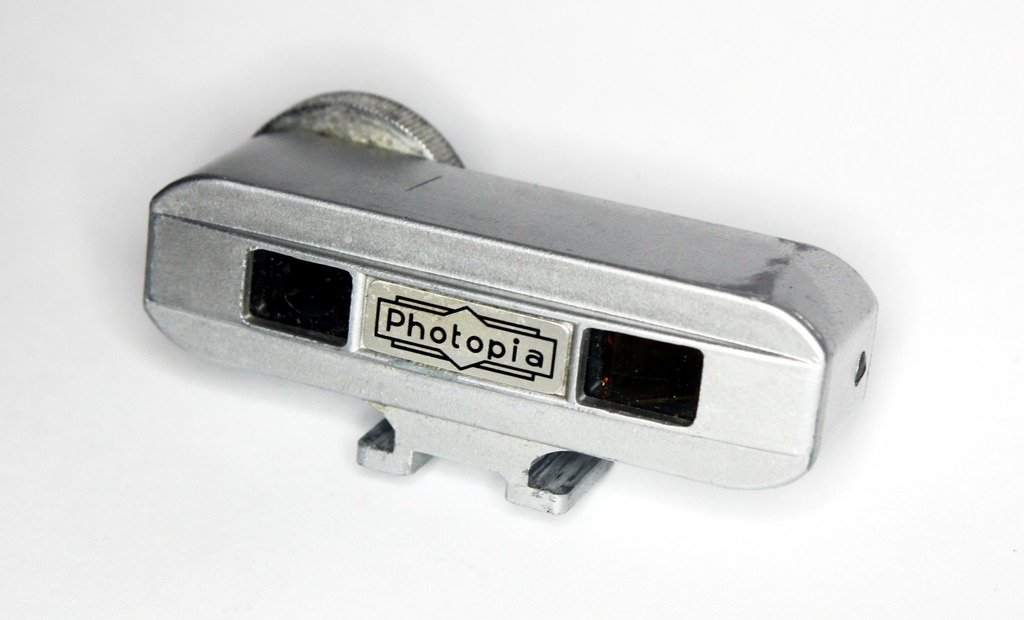
Photopia rangefinder

My very crudest cameras have fixed-focus, and the most advanced have split-screen focussing. But there are some that have so-called “guess focussing“. My cameras that do this are a Braun Paxette Electromatic II, a Halina Paulette Electric, and a Voigtländer Bessa. You have no idea what the image will look like, as the viewfinder is totally separate from the main lens. These lenses do have a dial on them to help with setting the focus properly, but how do you know how to set it? That tree could be thirty feet, or forty. Or fifty.

Photopia rangefinder

Enter the rangefinder. This nifty device has two windows that point at your subject, and one viewfinder that the photographer looks through. You see two ghost images of your subject, and as you adjust the knob, the images move around. When the two images are perfectly aligned, you look at the dial and read off the distance. Then you just set the focus ring to this distance. Simple!

Photopia rangefinder

You can pick up 35mm rangefinder cameras cheaply from eBay, but I decided instead to buy a standalone rangefinder. This Photopia one will sit in the hot shoe (or sometimes “accessory shoe”) of any camera.

Realt light meter

Only three of my cameras have any sort of automatic metering. They range from full automatic (Canon EOS 300) to semi-automatic (Canon AE-1 Program) to a needle that waves around (Halina Paulette Electric). All the rest require the photographer to work out what the settings should be.

Of course, the sunny sixteen rule is a huge help here, but sometimes it’s no use. What if there’s a weather condition that’s not sunny, overcast or shade? What if you are taking a photo indoors? A light meter is the answer to your problems.

You can get all sorts of light meters, but I think the prettiest ones are the ones with needles that move around. I found a French Realt meter on eBay for a few quid, and bought it. It’s selenium-based, so not very accurate, but that’s half the fun.

Realt Photo light meter

The background scale behind the needle slides out, and you replace it with the relevant scale for the film speed you are using. Pretty neat. If you have a film for which there exists no scale (and since this dates back to 1949, that’s anything above 100 ASA) then you remove the scale altogether and read off the EV (exposure value) – which you can convert to real settings for your camera by looking them up in a table.

Canon power winder

This is one of things I bought just because I could, and because it was cheap. My Canon AE-1 Program has a lever to wind on the film. This makes a nice sound and feels satisfying, but can slow down the momentum of taking pictures rapidly. Often, I forget to wind on, and I don’t realise until after I’ve set up the next shot and then find the shutter won’t fire.

Canon AE-1 Program with Power Winder

As it was only a fiver, I bought a Canon Winder A. It does what it says on the tin – it winds on the film and can achieve a “few” frames per second. It doesn’t say how many, and I haven’t measured it. More to the point, it makes the camera look big and professional!

Success with infrared photography

A while back I took an interest in infrared photography, and I bought a couple of rolls of Maco 820c infrared film. Using infrared film involves a huge amount of trial and error, and unlike digital cameras, you can’t take one or two pictures and check after each one. You have to shoot a whole film.

My camera’s light meter seemed to be responsive to infrared light, so I let it handle the exposures. Unfortunately I now know that the readings were nonsense, because the film came out almost entirely blank. The pictures that I salvaged weren’t good enough for my photo blog but I did write about the experiment.

This time, with my last roll of Maco film, I decided against trying to do any formal kind of metering. I left the aperture either at f/5.6 or f/8, as it seemed sort of sensible. You don’t want the aperture too small, because the longer wavelength of infrared light will cause diffraction at the diaphragm more easily. Equally, you don’t want it too big because this makes the depth of field smaller. Focussing infrared is already difficult as you can’t see it with your eyes, and has to be done using a red dot on the focus ring. By having a larger depth of field, you can get away with a larger inaccuracy before it looks blurred.

I put the camera in bulb shutter mode and guessed at the exposure time, judging by how brightly the sun was shining, and how warm it felt on my face. I generally exposed for between 5 and 30 seconds.

This time – great success. Practically every image was exposed well. A handful were a bit under- or over-exposed and had lost detail in shadows or highlights, but what can you expect when you choose the exposure time by looking at the sky?

I took a few pictures of a fire in a chimenea. These came out completely blank, so I guess the fire wasn’t emitting anywhere near as much infrared radiation as I thought. I suppose while it feels very hot, it isn’t that bright to look at. The film is sensitive up to 820nm and the filter allows wavelengths longer than 720nm. This is a reasonably wide range, but it’s still “near infrared” (almost-red light) rather than “far infrared” (heat).

The end result is that I’ve created images that are ghostly and every bit as “odd” as I had hoped, from looking at other people’s work. You can see the best pictures from the film on my photo blog.

Infrared photos

I’ve dabbled with infrared photography before, but not had much luck. This time, I’m delighted with the results. If you want to read more about my method, please have a look at my other blog. If you just want to see the pictures – well here they are.

Blue skies appear black and foliage appears white, giving the impression that you are looking at a negative. Until you notice that buildings and other objects are the colour you would expect. Weird, huh? 🙂

The images are naturally very contrasty too, which is a style that I like in black & white. The overall effect, in my opinion, is a collection of photos that grab your attention. They are dramatic, and they look “wrong” somehow. However, I can assure you that I have not Photoshopped these at all.

Firstly here are a couple of shots of Royal Fort House.

And two of the H H Wills physics building – in particular, the Tyndall lecture theatre.

A view from Brandon Hill park.

This is College Green in front of Bristol Council House.

This picture shows Bristol harbour. The blur was caused by a boat that passed during the exposure.

This view shows a line of different types of tree in Oldbury Court estate. The trees are all a similar colour when viewed in colour, but in infrared they appear a variety of different shades.

This is a maple tree.

And finally, here’s a view of the back of Osborne Villas.

Note: These pictures were taken with a Canon AE-1 Program SLR with a Canon f/1.8 50mm lens and Maco 820c infrared film. The film was developed in Ilford Microphen at stock concentration.

Life cycle

For those that don’t know, I work on a university campus. I graduated from the same university a few years ago.

Back in June, there was a series of graduation ceremonies. There were smart-looking graduands in their suits and gowns, strolling around looking the business. There were proud parents, beaming with delight that their children had completed their degrees.

For the first couple of years after my own graduation, I was so glad to be free from the educational system that I wasn’t particularly interested in the educational aspect of the following cohorts. This year, I think I’m suitably distanced from exams, revision and essays that I can appreciate watching others benefit.

For some reason, I too felt a swell of pride as I watched the scores of robed graduates-to-be.

Now the new year has started, and this week is Freshers’ week. Everywhere you look, there are new students. Lots of excited faces as they discover new places and meet new people. I’m a teeny bit jealous – I remember how exciting the start of my undergraduate career was.

When I started at university, I was eighteen and I felt fully grown up. I’m vaguely aware that I’ve changed in the years since then, but I don’t feel much different in myself. Looking at the new cohort, I can’t help but see children. I can’t believe their parents would let them move away to a strange city – surely they are too young?

And that’s when it occurred to me. I’m getting old. Reminiscing about “when I was your age” makes me feel like some sort of grandfather figure. I don’t mind though – I like my job, and I like being on a university campus: surrounded by intelligent people of different ages and specialisms.

I’m looking forward to the next graduation season now 🙂

Autoradiographic plates

Outdated medical technology isn’t normally the kind of thing I’d be interested in, or would write about – but I was given some old glass autoradiographic stripping plates. I didn’t know what they were at the time – I assumed they were normal photographic plates, but I’ve done a little light reading.

Autoradiography

The gist of autoradiography is that you:

  • inject a creature with a radioactive chemical
  • allow the radioactive blood to be pumped around its body
  • kill it
  • cut it into thin slices
  • stick the slices onto an autoradiographic plate
  • leave the radioactive slices stuck on the plate for days or weeks while the image forms – in effect a contact print but the “illumination” is provided by the sample itself, rather than an external light source
  • develop the plate in the same way as normal photographic prints

I found the following account in the Journal of Anatomy, 1978:

The investigation was carried out on 10 days old rats. Of the 11 animals used one served as a control and the rest were each injected intraperitoneally with a single dose of tritiated thymidine (2 μCi/100 g of body weight). The rats were killed by decapitation either 2, 12 or 48 hours after injection. The knee specimens were collected, fixed in absolute alcohol for 48 hours and then washed in distilled water. Cryostat sections 7-8 μm thick were cut and mounted on glass slides coated with a thin layer of gelatin. The sections were then stored in an oven at 37 °C.

J. Anat. (1978), 126, 3, pp. 547-554

The article continues to describe how the plates are developed and treated afterwards, which seems fairly typical of any printing done in a darkroom.

This is all good and well, but I have no intention of force-feeding a rodent some Red Bull and then cutting its head off. I’ve hardly been able to find any data about these particular plates – marked as Kodak AR.10. However, both the leaflet with the plates and the previously referenced article mention using a dark red safelight, which implies that the plates are indeed sensitive to visible light as well as X-rays and γ-rays.

Sensitivity to visible light sounds much more useful to me.

Making my own contact prints

As I had a box of 12 I thought it might be fun to try making some prints. And as they were free (saved from the bin!) there’d be nothing lost even if they’d expired or if I ruined them. The plates are 4¾ × 6½ inches, which is a nice size for a novelty glass print (I think).

I started off trying to make a simple contact print, by placing a heart-shaped pad of post-it notes on the plate and exposing under the 60W bathroom light for one minute. I then developed in Ilford ID11 for five minutes, diluted 1:1 with water. I washed the plate in stop bath for one minute and fixed in Ilford Rapid Fixer for two minutes.

The plates certainly hadn’t expired, as the area exposed to the light was black, and the area under the post-it pad was clear. However, the outline of the pad was extremely blurred to the point where it wasn’t possible to tell what it was. I think this was worsened as I had accidentally had the plate upside-down, with the emulsion on the opposite side of the glass to the pad.

I tried again, this time with the emulsion face up. The result was hardly any better. I was disappointed, since if I couldn’t make a simple contact print of a white heart on a black background, the chances of doing anything else successfully were slim at best.

Building an enlarger

My original plan, if the simple contact prints had been successful, was to make some more contact prints of some 6×9 cm 120-format negatives on the plates. They would certainly look unusual. Having failed at any sort of contact print, I wondered if it would be possible to project an image onto the plate.

I don’t have an enlarger or a projector, but I do have some very crude cameras that I thought might work in reverse. Using a 1929 Voigtländer Bessa folding camera, a porridge box and a light bulb, I managed to project a 120-format negative onto my wall in a dark room. As you can see, I’ve placed a book on top of the box to keep it still, and propped up the nose of the camera with a smaller box. You can also see the silver shutter release cable. Finally, I draped a black T-shirt over the entire arrangement, allowing just the nose of the camera to protrude, because it was leaking light quite awfully.

My homemade enlarger

The image of the 120 negative was reasonably sharp, but at the camera’s closest focusing distance of four feet, the image stood some 18 inches tall. For too large for a 6″ plate. After a bit of tinkering with some card and I managed to make a holder for a strip of 35mm negatives. When projected, these produced images that were still somewhat larger than the plates, but I thought it would be OK to “crop” them and represent only the central area of the negative on the plate.

Making the image

Given that one minute under a normal bathroom light had produced roughly the right exposure, I reasoned four minutes using a 40W bulb in my enlarger (significantly dimmer) would probably be OK.

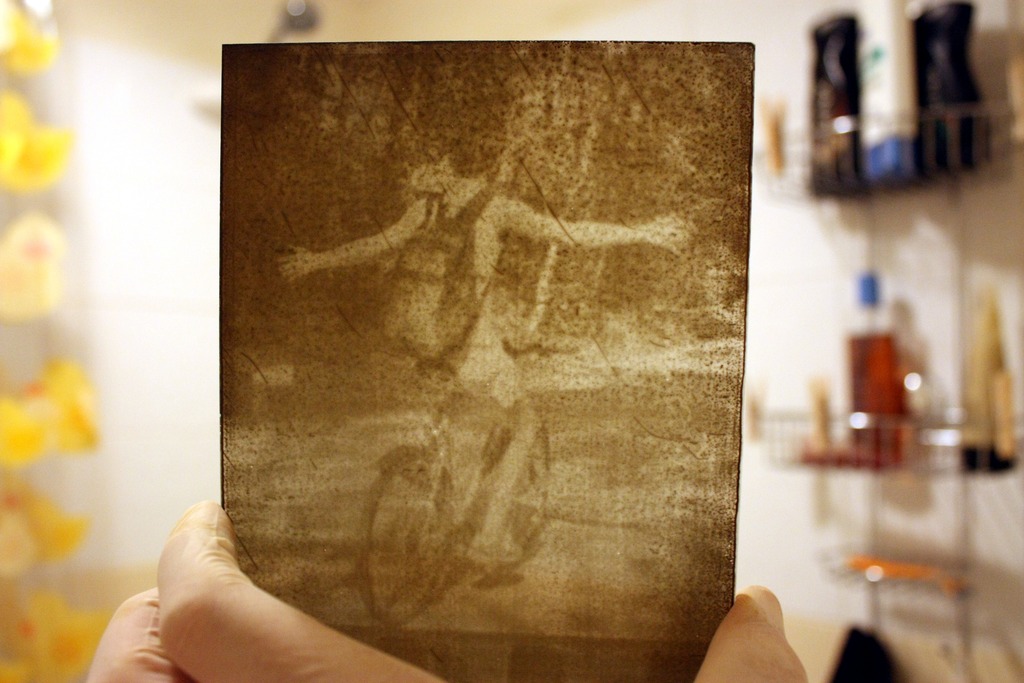
After exposure, I processed the plate the same way I had done before. But this time, success! Here’s my finished plate – a picture of my brother riding his bike. (You can see the original image on my photo blog).

My finished plate

Given that the grain is kind of awful, I would guess that the exposure time was too short and the development time was too long. I still have plenty of plates remaining, so I will try more like this after I’ve selected some more of my negatives from the archives. I will probably try exposing for ten minutes and developing for three.

I don’t know about you, but I think this retro-looking plate is incredibly cool. Anyone can do anything with a DSLR and Photoshop, but I think it’s more fun to play with expired X-ray plates and cameras from before my grandparents were born 🙂