Polaris, the pole star

I’ve taken star trail photos before, but this time I made a special effort to include Polaris, also known as the pole star or the North star. It is very close to the celestial North pole, meaning all the other stars appear to rotate around it.

At first I was annoyed that two or three aeroplanes crossed the frame in the 45 minutes it took to make this picture, but actually I think the lower, continuous aircraft track adds something to the picture. I don’t like the dotted line, though.

Jupiter II

Well after last night’s astrophotography session with a 400mm f/5.6 lens, and 3Γ— teleconverter, I decided to try again with an even longer optical system.

I rummaged a 700mm f/11 telescope and used the same 3Γ— teleconverter, for an effective focal length of 2.1m. This provided almost twice the magnification of last night’s setup, albeit with a much more unwieldy telescope which is extremely difficult to aim accurately, and takes about 30 seconds to stop wobbling after I adjust it.

Jupiter

As you can see, this image is larger than the previous attempt. If I want to improve further, I will need all or any of the following:

  • A lens with greater magnification, to achieve greater resolution on the sensor
  • A faster lens. At this magnification using a shutter speed any slower than 1/30 causes Jupiter to be blurred
  • A camera with a higher pixel density sensor, to achieve greater resolution
  • A motorised tracking tripod, to ease the process and to allow me to shoot slower than 1/30 and collect more light
  • A camera with a lower-noise sensor. I’m using a several-years-old Canon 450D, which is not renowned for its high ISO performance

All of these are expensive, so don’t hold your breath πŸ˜‰

Jupiter

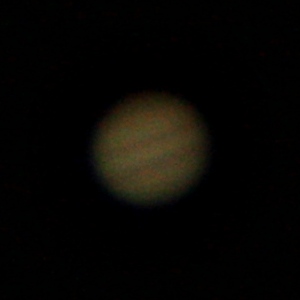
Last night the sky was clear and I noticed that Jupiter was shining brightly. I decided to try and take a photo of it. Being so far away, and not having a proper telescope, this is the best I could manage.

Jupiter

It’s blurry but it’s clearly recognisable as everyone’s second-favourite red planet πŸ˜‰

If you want to see more and better pictures of Jupiter, send me some money so I can buy a telescope! πŸ˜€

Sunset in sepia

If you read my blog, you might have seen that I recently posted some pictures from my new camera, the Horseman 980. One of them was a photo of the last few rays of evening sunlight shining through trees before the sun dipped below the horizon.

The picture was shot on black & white film, and the version here is a scan directly from the negative.

Evening sunlight in Oldbury Court

It’s a nice picture and I think it does give the impression of light. However, it doesn’t capture the orange warmth of the sunset. Yesterday I made a print from the negative in my darkroom, which I then toned sepia. This is a scan of the print.

Evening sunlight in Oldbury Court

Which do you prefer?

The sepia print is not as “widescreen” as the original negative. The negative was 6Γ—9cm but the paper I use for printing is 8Γ—10″, so it requires some cropping.

First go on the Horseman

No, not a man on a horse. My new Horseman 980 field camera! For geeks: it’s a view camera with movements. For normal people: it’s a complicated and fiddly camera, excellent for landscape work.

Horseman 980

I ran a film through the camera to make sure it was more-or-less working before taking any hard-to-repeat photos. The camera seems to be free of light leaks and other major faults, although this film produced some rather thin negatives. Might be an inaccurate shutter or aperture, or poor development of the film on my part.

First let me start with a simple demonstration of what the movements can do. The first picture of Brunel’s bridge has the camera in normal alignment. The picture looks “normal”.

Clifton Suspension Bridge

In the second image, I have tilted the lens away from bridge and in doing so, I have caused only the very centre of the bridge to be in focus. The near and far bridge towers are blurred. This can be a bit of a gimmicky effect, but it makes the subject look like a model. This is commonly called tilt-shift miniature because the camera is physically tilted and shifted.

Clifton Suspension Bridge

I’ve used the same effect again with this clock tower in Stoke Park. I’ve also used front rise to “look up” at the tower without it tapering towards the top. Unfortunately I appear to have double-exposed this picture by mistake.

Clock tower

And here are a couple more pictures, taken around Bristol.

Evening sunlight in Oldbury Court
Dower House

Like I said, this was mainly a test roll to make sure the camera was working and to start to get a feel for it. I hope there will be lots of improving pictures on this website in future.

Horseman 980

Released 1968

This Horseman is my first foray into the world of camera movements. As much as I love my Mamiya RB67 (which is another professional grade medium format camera), it wasn’t always the right tool for every job, and sometimes I needed perspective correction or detailed control of the plane of focus.

The Horseman is heavy, slow, cumbersome and requires me to duck under a dark-cloth if I’m out and about. But it offers extraordinary levels of control over every aspect of picture-making and will allow me to take my photography to a new level.

Horseman 980
Horseman 980

At a glance

Lens 80mm lens board, Copal #0 or #1 shutter
Film 120 6Γ—9cm
Focus Focal plane ground glass or rangefinder
Meter None

Horseman 980

Today my latest camera arrived – a Horseman 980. It’s what you might call a field camera. The body of the camera can be adjusted in all sorts of ways to control perspective and focus in the photo. I haven’t had the chance to use it yet since it’s dark outside, but I hope to shoot something at the weekend as a test run.

For the time being, please accept this snapshot of the Horseman on its tripod. I think it’s a beautiful object.


The Tour of Britain 2011 – Exeter to Exmouth

For those that don’t know, I’m a cycling fan. Today, Stage 5 of the Tour of Britain set off from Exeter and meandered around Devon for 180km, before ending up at Exmouth. It was a roughly circular route, so we managed to see the race start at Exeter, pass by at Crediton, and finish at Exmouth.

Exeter

It was very busy in Exeter, with crowds several deep at the railings. It wasn’t really possible to use a camera properly, but I tried holding it at arm’s length above the crowd. Unfortunately it seems I was mainly pointing it in the wrong direction and I only got one or two decent pictures. This picture shows the race departing, only about 100m from the start line.

After the cyclists had gone, the queue of team cars joined the procession and followed them along the course.

Crediton

While the cyclists were off on Dartmoor, tackling the windy and steep roads near Hay Tor, we had plenty of time to get to Crediton. The high street is quite straight and wide so we found a location where there was good visibility and the crowds were sparse. It was about one mile before the intermediate sprint, so we hoped there would be the beginnings of a lead-out train.

As it happens, there was a breakaway group which was a minute or two ahead of the peloton. Unfortunately the downside of seeing the race in person rather than watching it on TV is that you don’t have the commentary, or a clue what’s going on as it happens around you. The race passes very quickly, too fast to see who is leading. So I’m not too worried about the details, but here are some pictures of the cyclists passing.

So here’s the breakaway, with a rider from Sky at the front, closely followed by a rider from HTC Highroad. Unfortunately they wear their numbers on their backs, so I don’t know who they are πŸ˜›

Shortly after, the peloton rolled through the usually quiet town.

Exmouth

We hardly had any time to get from Crediton to Exmouth, and on the assumption that the town centre and seafront would be extremely busy and all the good places taken, we settled on a spot a mile or two up the road. We were treated to another wide, straight piece of road. There was a traffic island in the middle of the road so I stood on that and enjoyed the cyclists passing closely on both sides of me.

I had a word with one of the marshals who had access to the race radio, and he said that since Crediton the breakaway group had been caught, and that it was a bunch finish.

After the race had passed, we walked to the finish line. By then, all the cyclists had long gone, the awards had been presented, the team cars were nowhere to be seen and marshals were dismantling the course. But we had some fish and chips by the sea, so all was not lost. All in all, a good day for us, and a good day for the Sky and HTC Highroad teams, which both posted excellent results.

The highlights will be on TV a bit later on this evening, so I will be sure to watch them because I want to know what happened! I’m also keen to see if the cameras caught me in any of the 3 locations that we saw the Tour.

Stage 5 Results

Stage results
1 Mark Renshaw HTC Highroad
2 Mark Cavendish HTC Highroad
3 Robert FΓΆrster UnitedHealthcare
Overall classification
1 Lars Boom Rabobank
2 Geraint Thomas Sky ProCycling
3 Boy Van Poppel UnitedHealthcare
Points competition
1 Geraint Thomas Sky ProCycling
2 Mark Cavendish HTC Highroad
3 Lars Boom Rabobank

Crater face

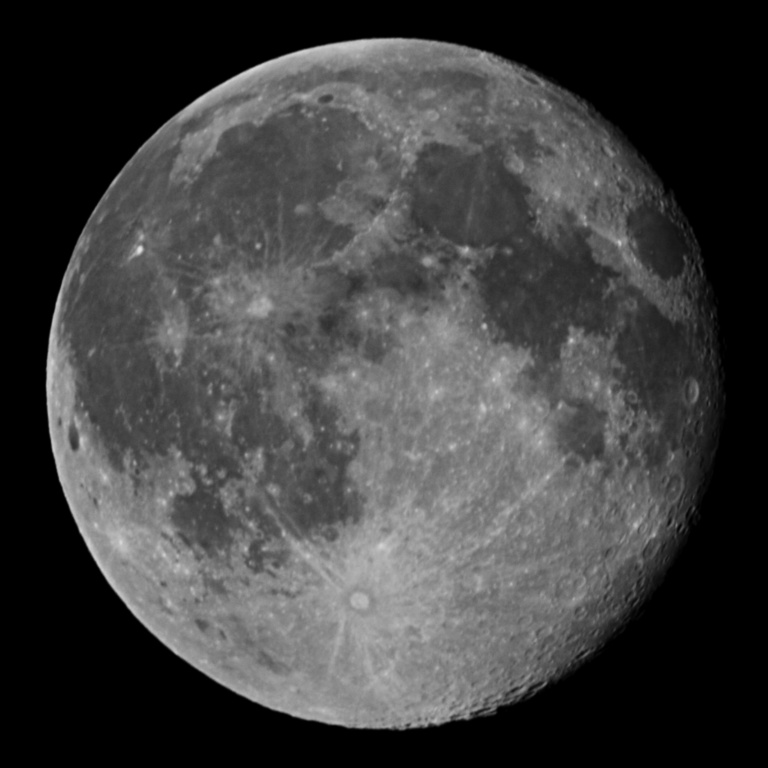
Sorry, I’m running out of original titles for pictures of the moon. Last time I posted one, I said it was the best ever. This one is loads better, though.

Composite of 4 frames, each shot at ISO800, 1/60s, f/11 on Canon 450D with Tokina 400mm f/5.6 lens and 3Γ— teleconverter. Aligned and stacked with ale, green channel extracted, unsharp mask applied with radius of 20 pixels, and slight contrast enhancement. Simples!