On my Kubernetes homelab, I am running a handful of workloads that support GPU hardware acceleration, so I decided to look into it. I had to do a lot of reading different sources to figure out how to put this together, and so I present my findings here so hopefully someone else can benefit. ManyContinue reading “Intel GPU acceleration on Kubernetes”
Tag Archives: Kubernetes
Kubernetes Node Feature Discovery and Network Speed
For those of us who run Kubernetes on-premise on physical hardware, it is entirely possible that not all your nodes have the same hardware. For memory and CPU cores, Kubernetes magically does the right thing and each node advertises how many cores and how much memory it has, and workloads are scheduled on a nodeContinue reading “Kubernetes Node Feature Discovery and Network Speed”
Kubernetes Homelab Part 6: Deployments
Welcome to part 6 of my Kubernetes Homelab series. In the previous posts we’ve discussed the architecture of the hardware, networking, Kubernetes cluster, and infrastructure services. Today we’re going to look at deployment strategies for applications on Kubernetes. My goal for my homelab is not necessarily 100% automation, but I would like the ability toContinue reading “Kubernetes Homelab Part 6: Deployments”
Kubernetes Homelab Part 5: Hyperconverged Storage (again)
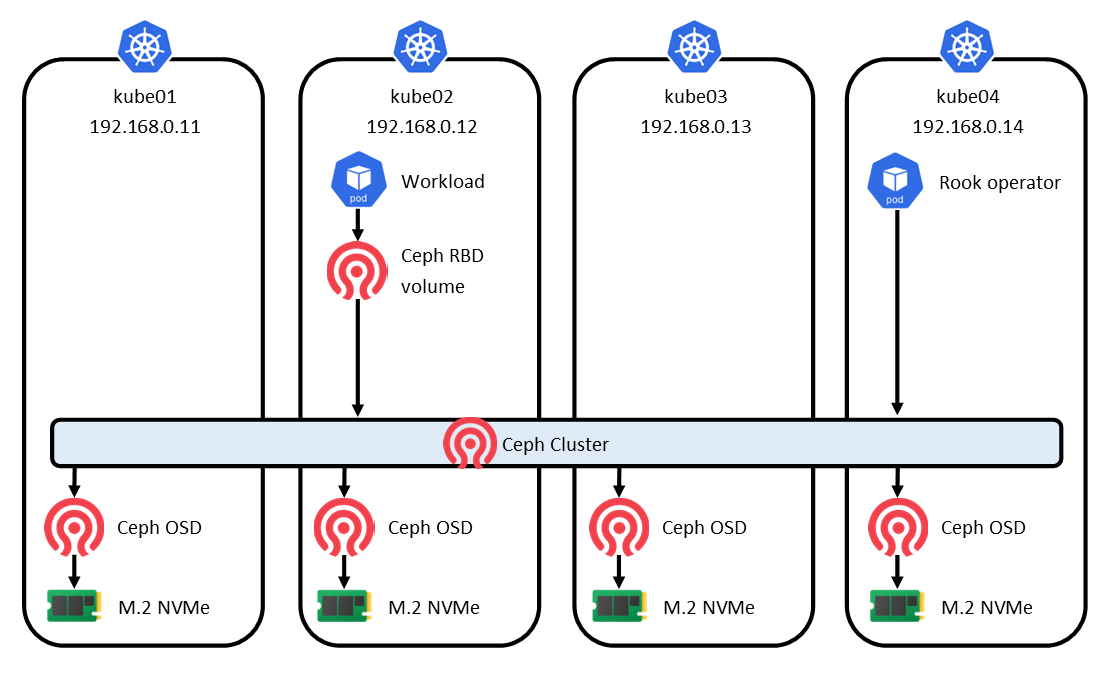
Part 4 of this series was supposed to cover hyperconverged storage with OpenEBS and cStor, but while I was in the middle of writing that guide, it all exploded and I lost data, so the blog post turned into an anti-recommendation for various reasons. I’ve now redesigned my architecture using Rook/Ceph and it has hadContinue reading “Kubernetes Homelab Part 5: Hyperconverged Storage (again)”
Kubernetes Homelab Part 4: Hyperconverged Storage

Sorry it’s taken a while to get to the next part of my blog series. This section was supposed to be about hyperconverged clustered storage in my cluster, but I unfortunately ran into a total cluster loss due to some bugs in MicroK8s and/or dqlite that maintainers haven’t managed to get to the bottom of.Continue reading “Kubernetes Homelab Part 4: Hyperconverged Storage”
Kubernetes Homelab Part 3: Off-Cluster Storage
Welcome to part 3 of the Kubernetes Homelab guide. In this section we’re going to look at how to provide off-cluster shared storage. If you haven’t read the other parts of this guide, I recommend you check those out too. Out of the box, MicroK8s does provide a hostpath storage provider but this only worksContinue reading “Kubernetes Homelab Part 3: Off-Cluster Storage”
Kubernetes Homelab Part 2: Networking
The next part of our look at my Kubernetes homelab is a deep dive into networking. If you haven’t read the other parts of this guide, I recommend you check those out too. On the surface, my network implementation is very simple. The cluster nodes, the NAS and the router are all on the same /24 privateContinue reading “Kubernetes Homelab Part 2: Networking”
Kubernetes Homelab Part 1: Overview
A lot of people have asked me about my home Kubernetes cluster, and so I have decided to put together a series of blog posts about the architecture. I’m going to split it into sections, with each section focusing on a specific area. If you haven’t read the other parts of this guide, I recommendContinue reading “Kubernetes Homelab Part 1: Overview”
Making a public music streaming service with Navidrome
For a while, I’ve wanted to set up some kind of public music player, to allow people to stream and download music I’ve recorded for free, without having to make an account. First I tried using Bandcamp but I found the user interface on the free tier to be awkward, and it took too longContinue reading “Making a public music streaming service with Navidrome”
Using TrueNAS to provide persistent storage for Kubernetes
A while ago I blogged about the possibilities of using Ceph to provide hyperconverged storage for Kubernetes. It works, but I never really liked the solution so I decided to look at dedicated storage solutions for my home lab and a small number of production sites, which would escape the single-node limitation of the MicroK8sContinue reading “Using TrueNAS to provide persistent storage for Kubernetes”
 Jonathan Gazeley