Film

I decided to have a quick count of the film I have in stock.

Film

It seems I have 37 rolls of 120-format film, and 10 rolls of 135 (35mm) format. That’s a total of 730 pictures, assuming I shoot the 120 film as 6×7 negatives with 10 frames per roll, and the 135 film with 36 frames per roll. That’s getting on for around £200 worth.

For comparison I’ve also included a tiny 8GB MicroSD card which would be able to hold about 3000 pictures from my DSLR.

In stock, I have:

  • Ilford FP4 Plus (my favourite B&W film)
  • Ilford HP5 Plus
  • Kodak Ektar 100 (my favourite colour negative film)
  • Fuji Pro 160 NS
  • Ilford Pan 100
  • Tudor 200 (embarrassingly cheap, but cheerful)

Film is fun, kids! 😀

Bristol from a vantage point

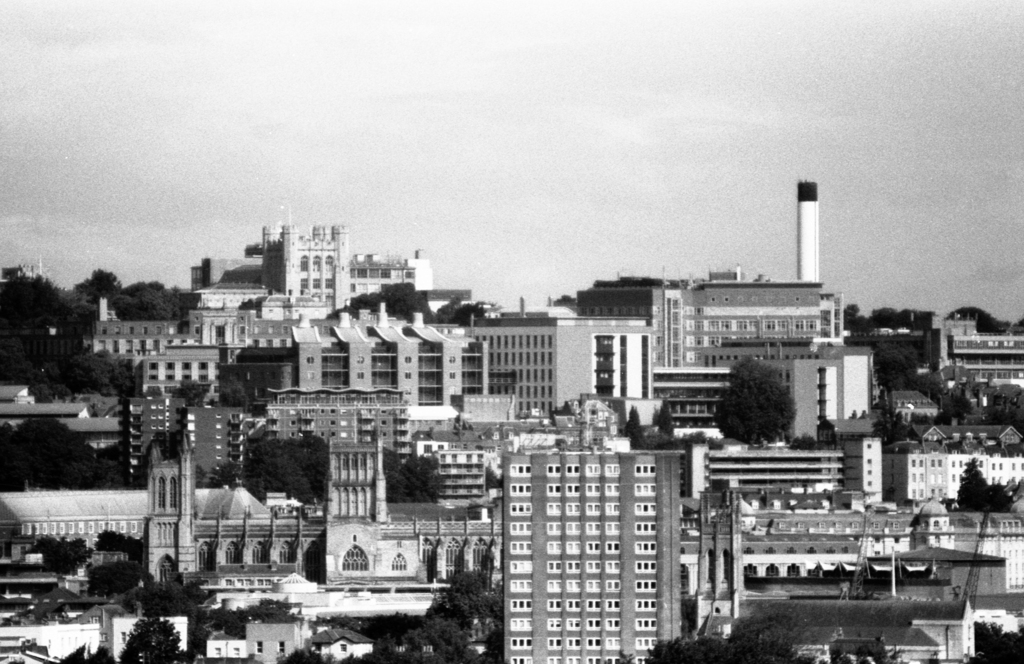
While I was out taking my panorama of Bristol at the weekend, I also packed a long lens and went to see what I could see. This was also the first outing of my “new” Canon FTb, which I bought mainly for astronomy. Paired with a 400mm lens, it’s an excellent combination.

As a cyclist, I frequently curse Bristol’s steep undulations. But as a photographer I love them, because they let me take shots like these. This one centres on the campus of Bristol University.

This one shows a tower block in Bedminster and a slightly more distant office building in the centre.

The cranes on the horizon are being used to construct the new hospital at Southmead, and are almost five miles away.

The tower block in Bedminster again, this time seen with the rounded building in Cabot Circus and the square one at Castlemead.

Cabot Tower, on Brandon Hill.

Here’s Purdown BT tower. It’s almost 4½ miles from where I took the picture.

I’m not quite sure where these houses are, but I like the higgledy-piggledy arrangement of rooftops.

A little bit more zoomed out, here we see Brunel’s Clifton Suspension Bridge towering over south Bristol.

The prominent central buildings, (e.g. the University, Broadmead and Clifton Suspension Bridge) are about three miles from my vantage point on Nover’s Common. Three miles through the atmosphere of a city causes a lot of haze, and the pictures are lacking in sharpness and contrast if you inspect them closely. Given that the majority of urban haze is in the ultraviolet and blue regions of the spectrum, I could probably achieve much better sharpness with an orange filter, which would not register the blue end of the spectrum. It didn’t look that hazy to the eye, but human eyes are less sensitive to ultraviolet radiation than camera film, and it’s also surprising how good the brain is at showing you what you want to see!

The images are also quite grainy. This is probably due to the fact I overexposed a little and pulled the films in development. Next time I will be more careful with my metering!

Temporary Linux swap in user space

Once in a while, you might run into a situation where you need some extra RAM (or swap) for a short time. (I ran into this situation today while stitching some really enormous images in Hugin). Adding a new swap partition isn’t practical if you only need the extra swap space for a short time.

If you have enough space in your home directory (or elsewhere on your filesystem) then you can use this as a temporary swap file without making a partition.

First we allocate the file that will be used as swap. This is where we set the size. In this example, I’ve chosen 10GB.

truncate -s 10G ~/tempswap

Now we tell this file to be a swap file:

mkswap ~/tempswap

And finally we can tell our system to use the new swap file (on top of any existing swap files):

sudo swapon ~/tempswap

To check on your memory and swap availability and usage, try:

free -m

This swap file won’t be used as swap on next boot unless you add it to your /etc/fstab, but you’ll still have to delete the file to get the space back. To clear up after yourself manually, do this:

sudo swapoff ~/tempswap
rm ~/tempswap

A selection of black & white views around Bristol

These pictures are an odd assortment from a film I’ve had in my camera for a while.

This is the old chimney on Troopers Hill.

A black & white view of Dower House. This was taken at the same time of my panorama of east Bristol.

Not too far from Stoke Park and Dower House, you can see the BT tower at Purdown.

This is a memorial stone to Elizabetha Somerset, Duchess of Beaufort. It’s also in Stoke Park, and the inscription in Latin reads:

ELIZABETHA SOMERSET
CAROLL DUCIS BEAUFORT FILIA SECUNDA HIC OBIIT VII
MAII MDCCLX
RESTITUTUM ANNO MMIV

Another panorama of Bristol

Yesterday I shot a panorama of east Bristol from a vantage point in north-east Bristol. It turned out OK, but it didn’t show the characteristic landmarks in Clifton and the centre. So today, I went to south Bristol and found a vantage point in Nover’s Common that overlooks most of the city.

This panorama starts at the left with Bedminster Down, including the BBC radio mast. It swings across an industrial estate into Bedminster. About one-third along, you can see the blue and red stands at Ashton Gate football stadium. Just up and left a bit from the stadium, you can see Ashton Court Manor. This is actually on the other side of the River Avon, which the Suspension Bridge crosses. About halfway along, you can see three red-brick warehouses by the docks. Close to them, the majestic Clifton Suspension Bridge. Panning further right, the traditional church spire belongs to Christchurch, Clifton, while the modern double spire is the Catholic cathedral, also in Clifton. In the foreground, the distinctive red and white blocks are flats in Bedminster.

About two-thirds along, the slender tower crossing the horizon is the Cabot Tower in Brandon Hill nature reserve. A bit further right, the fat tower is the Wills Memorial tower, part of the University of Bristol. Further right still, the square building with turrets is the H H Wills Physics building at the University. Surrounding this building, most of the other large building are part of the University, including the departments of chemistry, engineering and medicine. Slightly down the hill and more in the foreground is Bristol Cathedral.

The multi-storey building with the silver column up the side, some three-quarters along, is Colston Tower. There are numerous other multi-storeys here but the next notable one is the squat-looking one. This is by the river on Victoria Street. Moving along rightwards, the red and white tower block is in Bedminster. The spire belongs to St Mary’s Redcliffe. The silver, rounded building is in Broadmead while the blocky one with the vertical stripes is the Castlemead tower. The beige tower block is very close to the red and white one we just saw.

Finally in the distance we can see the Purdown TV mast, and further still, the yellow façade of Dower House, where I stood yesterday to take my panorama of east Bristol.

On the map below, my vantage point is the southernmost one on the map, in Knowle.

[mappress mapid=”5″]

A panorama of Bristol

Today I went to Stoke Park, on the outskirts of Bristol with the main intention of photographing Dower House. Once I was there I noticed there was a great view of much of east Bristol spread out beneath me. The lighting wasn’t great, but I decided to make a panorama anyhow. I’ll likely go back one day to re-shoot the images with more favourable lighting (morning).

Here is the result, ranging from Dower House on the extreme left, with the M32 in the foreground. Approximately from left to right, you can see the districts of Downend, Fishponds, Frenchay, Kingswood, Speedwell, St George, Barton Hill, Lawrence Hill, and a glimpse of the tall buildings in the centre. On the very far right you can see the BT tower on Purdown Hill in Lockleaze.

Click for a bigger version, and then zoom and scroll at will in your browser.

Bristol panorama

One day I might have to add an annotated version of this panorama that points out some of the distinctive buildings, but for now you’ll have to make do with viewing some of them on a map. My viewpoint was one of the two northernmost markers, and I faced roughly south.

[mappress mapid=”4″]

For those interested in how this image was made – I took 8 photos with a Mamiya RB67 on 120-format film – that’s a 6×7cm negative. I chose to use Kodak Ektar 100 film, which is said to be the highest-resolution colour negative film ever made – just what I need for a job like this.

Back at home, I processed the film myself using standard C-41 chemistry. I scanned each frame in on my Epson V500 flatbed at 4800dpi. With the digital scans in hand, I fed them through Hugin to align, blend, merge and stitch them. The end result was a 537-megapixel image over 1GB in size.

The version on this website has been resized down for sensible viewing in a browser, and is just 2.6% of the size of the original. The detail in the original has to be seen to be believed, but if you want to see it you’ll have to come to my house 🙂

Spring comes to Oldbury Court

Note: This post was written in February but for some reason I forgot to hit the button publish it. Enjoy your belated Spring photo!

I know that each year, when the seasons change, I get all excited. It’s like I forget about the seasons within twelve months, and get all excited when it comes around again the following year. Last year, I posted excitedly about spring, and while it may still be only February, the sun was out today so I went for yet another photo walk in Oldbury Court estate.

Square format photos

This week’s Photo Challenge theme is square format photos, so I’ve been out and about with my LOMO Lubitel (“ЛОМО Любитель”) 166. It’s a cheap Soviet camera that takes square pictures natively.

The lens is not really designed for colour use and suffers badly from softness, vignetting, chromatic aberration and coma, so on paper it’s a terrible lens. In practice, it gives the pictures a sort of glowing, nostalgic feel.

One of these pictures will make its way into the Photo Challenge as an entry, but I’m not telling you which one! Check the Challenge results on Tuesday. 😉

The first three pictures are taken in and around Oldbury Court, while the fourth is a view of the belltower at St Matthias campus, UWE.