A house I walk past on the school run has recently installed an ultrasonic animal scarer – presumably to deter the urban foxes that are prevalent in the area. These devices are supposed to emit ultrasound that is too high for humans to hear, but makes a frightening or unpleasant noise for animals, who have much more sensitive hearing. They are triggered by motion, via an infrared sensor.
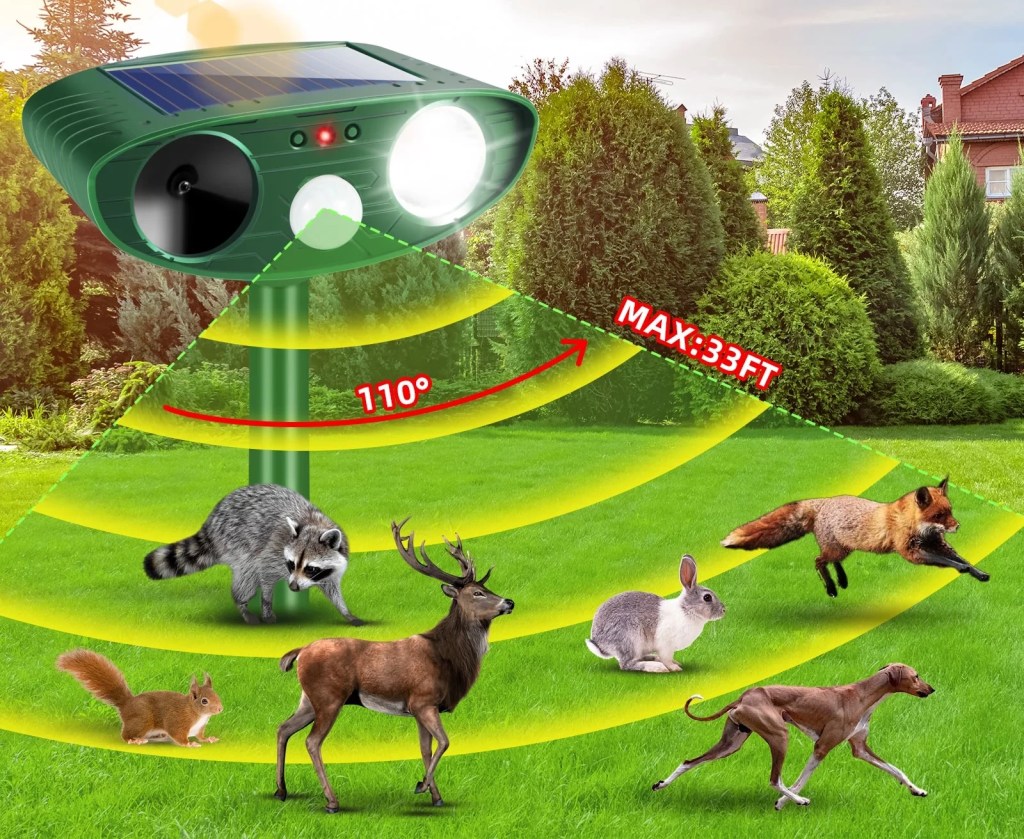
I noticed that I was able to clearly hear this animal scarer – it appeared to me as an unpleasant squealing or fizzing sound. I can’t think of a better way to describe it other than “it sounds like a migraine”. My 8-year-old daughter was able to hear it much louder than I was, to the point that it was physically uncomfortable for her. We always have to run past the house with her ears covered!
This got me thinking. The range of human hearing is widely said to be from 20Hz at the low end, up to 20,000Hz (or 20kHz) at the high end. As we age, the upper limit of our hearing reduces with healthy adults typically able to hear up to around 15-17kHz. These characters vary widely between individuals, but generally:
- 8,000 Hz should be easily heard by everyone with normal hearing
- 12,000 Hz is hard for anyone over 50 years of age to hear
- 15,000 Hz is difficult for anyone over the age of 40 to hear
- 17,400 Hz is a frequency that only teenagers can hear. [Most people over the age of 18 cannot hear this tone]
In my late 30s, I can hear all of those tones except 17,400 Hz. However I can feel some sort of weird sensation in my ears, so presumably it’s about on the threshold for me. With that in mind, why am I able to hear the “ultrasonic” animal scarer so easily? Surely that should be well above 20kHz, where no human could possibly hear it.
I don’t have any proper way of measuring ultrasound, but I do have a handheld Zoom H5 recorder. It is capable of recording uncompressed audio at a sample rate of up to 96kHz, so according to Nyquist’s law, it is theoretically capable of recording frequencies of up to 48kHz. I have no idea whether the microphones and circuitry are that sensitive, or even if frequencies above 20kHz are filtered out.
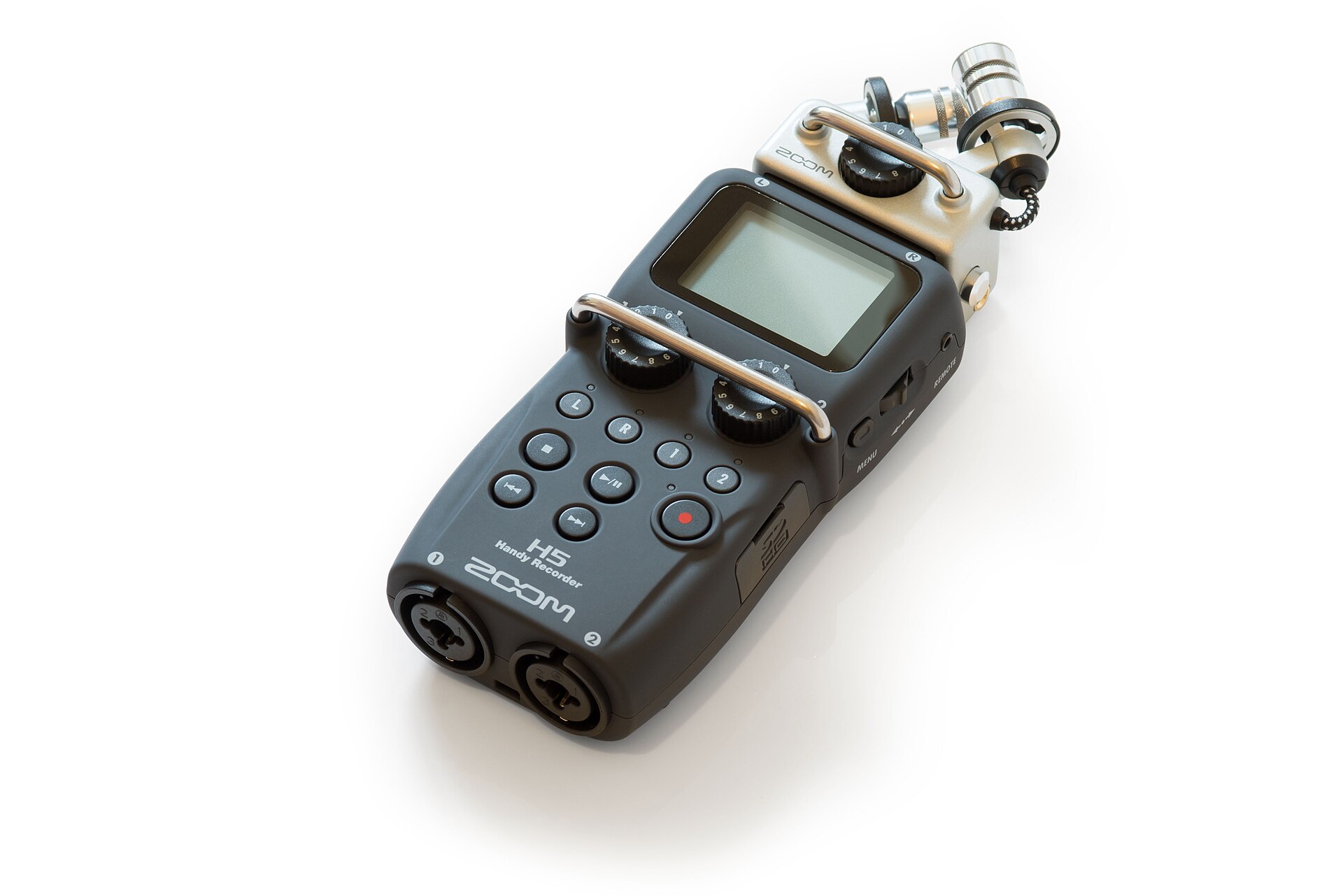
The next day, on the way to school, I took my recorder and captured the sound of the animal scarer. It was triggered by the motion of me walking past the house, and I was able to hear two bursts of ultrasound, a few seconds apart. Then I inspected the sound file in Adobe Audition, and used the spectral frequency display to make this plot. Time goes from left to right, and frequency goes up.
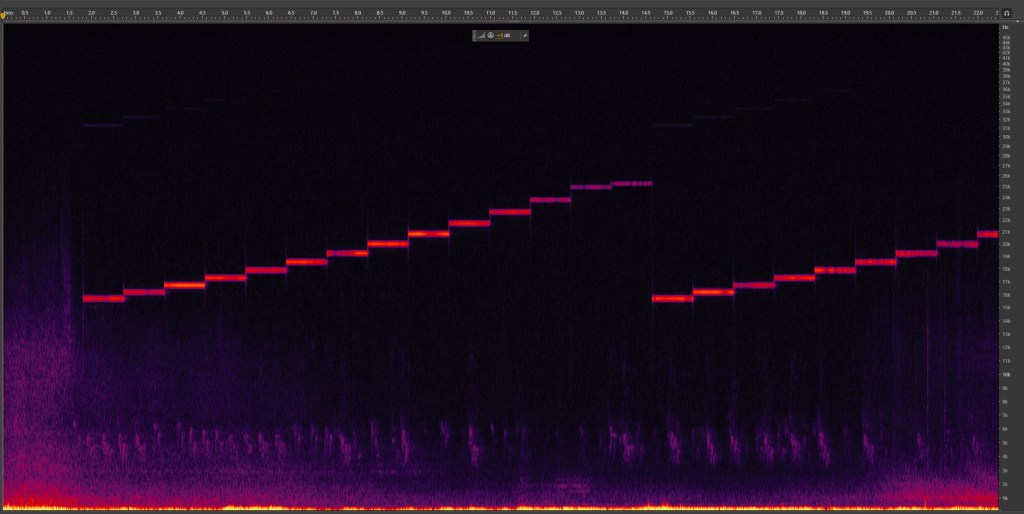
We can see from the plot that the Zoom H5 was easily able to record frequencies above 20kHz. We can also see that the ultrasonic animal scarer plays a scale of ascending notes, twice. This is why it appears as two bursts to me – I can apparently only hear the first few notes of the scale. You can even see that I stopped the recording because I thought the burst had finished.
If we look at the frequency scale on the graph, we can see that the lowest note of the scale is around 16kHz and the highest is around 21kHz. This is a pretty inconsiderate range, as virtually all children and young adults will be able to hear some or most of the sound. Even at the age of 38, I can hear the first three notes. And that’s before we even consider that the evidence is pretty mixed on whether they even work for keeping animals away at all.
I don’t really know what to do with this new-found information. Is it the done thing to knock on people’s doors and show them spectral frequency graphs? Like a religious preacher, but with science?
 Jonathan Gazeley