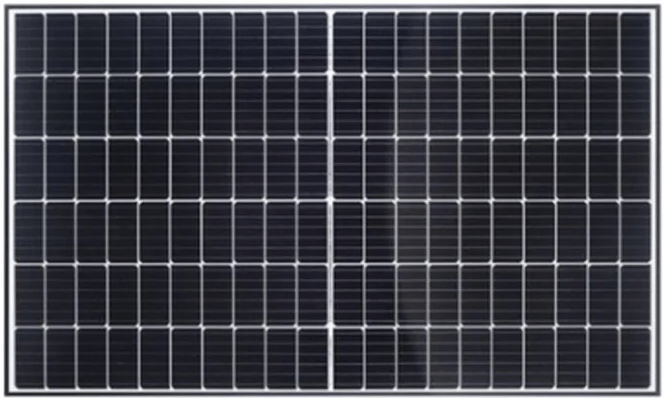
It’s a question I’ve heard asked quite a few times: why don’t EVs have solar panels on the roof? Then they wouldn’t need to be charged with a charger, would have infinite range, and would be using only green electricity!
It’s a fair question. To answer it, let’s have a look at some numbers.
How much energy do we actually get from the sun? Well, solar irradiance at the surface of the earth, the amount of sunlight energy falling on each square metre of Earth’s surface, is approximately 1100W/m². But this is an average figure across the whole globe. It is more at the equator and less at the poles. Here at my location in the UK at 51.5° North, my weather station has measured peak solar irradiance of ~1000W/m² at the height of summer. This limits the maximum energy we can ever get from the sun, regardless of the type of solar panels used.

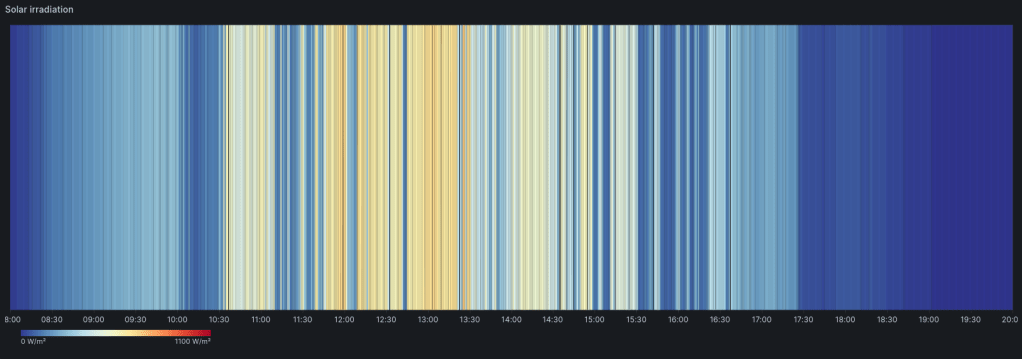
This graph shows the solar irradiance at my weather station over the daylight hours (08:00 – 20:00) of a typical sunny September day. The peak solar irradiance was more like 700W/m² with an average much below that. Note the gaps in the yellow/orange area, where clouds pass over.
Let’s be generous, and take 700W/m² as our figure of solar irradiance. We must also account for the efficiency of solar panels. The conversion efficiency of commodity solar panels is only about 25%, which further reduces the amount of useful electricity we can extract down to 175W/m².
How large actually is a car roof? I’ve just been outside to measure the useful roof space of a typical family hatchback (a Hyundai i30) and it measured 1.0×1.7 m, for a total area of 1.7m². A larger family car (a Ford Mondeo) would be able to offer 1.1×1.9 m for a total of 2.09m² of useful roof area if the roof rails weren’t fitted.

The Mondeo is more comparable in size to a Tesla Model 3, so let’s run with those dimensions. Multiplying the available roof area for solar panels (2.09m²) with the average useful solar irradiance in the UK (175W) yields a total electrical power of 366W or 0.366kW from the roof of a large family car.
To put this into perspective, a typical home EV charger operates at 7kW – more than 19 times more power (and therefore 19 times faster) than on-roof solar charging. Standard chargers found in public locations are typically 22kW and rapid chargers are 43kW, which is 60 or 117 times more power than solar charging respectively. Which? has a good overview of charger types.

Staying with the Tesla Model 3, the base model has a battery pack rated for 50kWh, which is fairly typical for today’s EVs. With solar charging alone, it would take 137 hours (almost 6 days) to fully charge. But solar panels only work in daylight hours, so in summer it would take more like 12 days!
The available power is obviously reduced even further in the winter months, on cloudy days or if you park in a multi-storey car park or under a tree.
So I guess this is our answer – it’s just too underpowered and too slow to be practical.
But why couldn’t EVs come with solar panels on the roof for emergency backup? Just enough charging capability to make sure you don’t get stranded? Or to add a few miles to the range?
Well, they could. But cars are manufactured with slim profit margins and solar panels are an expensive component to include for such little benefit. It just doesn’t make business sense.
 Jonathan Gazeley